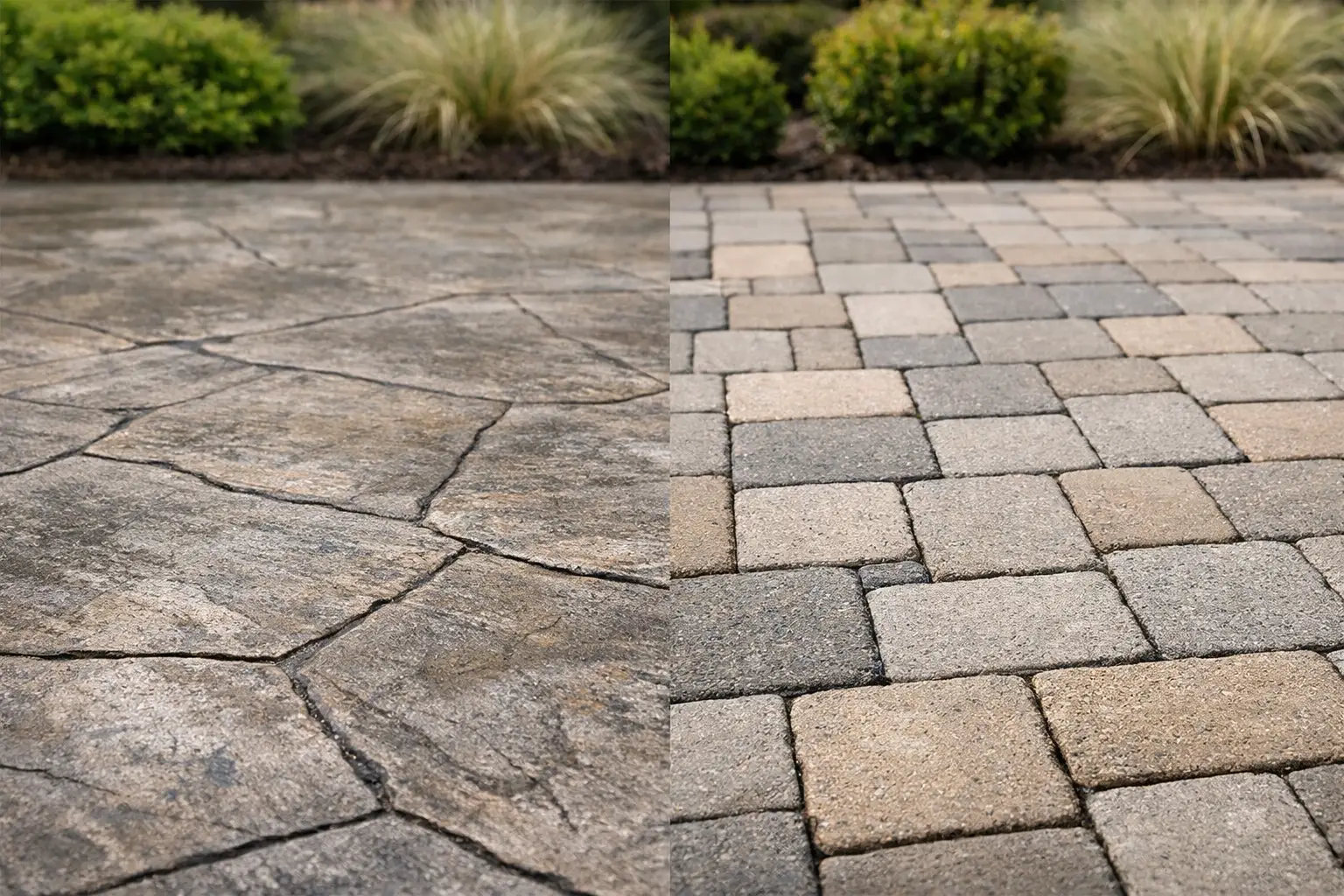
A patio can look great on day one and still be the wrong choice five summers later. That is usually where the stamped concrete vs pavers debate gets real - not in a showroom photo, but after heat, rain, traffic, weeds, settling, and repairs start testing the surface.
If you are deciding between the two, the right answer depends on how you use the space, how much maintenance you will tolerate, and how important long-term repair flexibility is to you. Both can work well. They just fail in different ways, cost money in different ways, and age differently.
Stamped concrete vs pavers at a glance
Stamped concrete is a poured slab finished with texture and pattern to mimic stone, brick, tile, or other materials. It gives you one continuous surface with a decorative look. Pavers are individual units installed over a prepared base, with joints between each piece. They create a segmented surface rather than a monolithic slab.
That basic difference affects almost everything else. A stamped concrete patio or driveway depends heavily on proper subgrade prep, mix quality, reinforcement, joint placement, drainage, and finishing. Pavers depend heavily on excavation depth, base compaction, edge restraint, bedding sand, and consistent installation. In both cases, the installer matters as much as the material.
Cost: upfront price is only part of the story
Stamped concrete usually has the lower initial cost for covering a larger area, especially when you want a decorative finish without paying for individual units. For many homeowners, that is the main reason it makes the shortlist. You can get a custom look, color options, and pattern detail at a price that often lands below premium paver installations.
Pavers typically cost more upfront because the installation is more labor-intensive and material costs are higher. Every unit has to be placed, aligned, cut where needed, and compacted correctly. On larger patios, pool decks, or walkways, that adds up fast.
But initial price should not be confused with lifetime cost. If stamped concrete develops major cracking or settlement in a visible area, repairs can be difficult to blend. If a paver section settles, the affected area can often be lifted, regraded, and reset without replacing the entire surface. So the cheaper install is not always the cheaper long-term option.
Appearance: one offers a clean slab, the other more texture
Stamped concrete gives a more continuous, unified look. If you want broad decorative patterns without many visible joints, it does that well. It also works when you want the appearance of stone or brick but prefer the look of a single poured surface.
Pavers bring more texture and variation. Because they are individual pieces, the finished surface tends to look more dimensional and more like traditional hardscape. Some property owners prefer that higher-end look, especially around pools, entry paths, and outdoor living areas.
This part is mostly preference, but there is a practical side to it. Stamped concrete can look excellent when freshly sealed, though some styles become dated faster than others. Pavers tend to hold a more classic appearance over time because the pattern comes from the units themselves, not just the surface finish.
Durability in Texas conditions
In North Texas, weather is hard on exterior surfaces. Heat, shifting soils, heavy rain, and freeze-thaw swings do not treat patios and driveways gently. That matters in the stamped concrete vs pavers decision.
Stamped concrete is durable when installed correctly, but it is still concrete. Concrete cracks. The real issue is not whether cracks can happen, but whether they stay minor and controlled or become wide, uneven, and obvious. Expansion joints and control joints help manage that risk, but they do not eliminate it.
Pavers handle ground movement differently. Because the surface is made of many pieces, small shifts in the base may show up as localized unevenness rather than slab cracking. That can be an advantage in areas with active soil movement. The trade-off is that pavers can settle unevenly if the base is not compacted properly or if water starts undermining the installation.
For driveways, load matters too. A stamped concrete driveway needs the right thickness, reinforcement, and base preparation to handle vehicles over time. Pavers can also perform well under traffic, but only when the system is designed for that load. Patio-grade work and driveway-grade work are not the same thing.
Repairs: this is where the differences become obvious
Repairability is one of the strongest arguments for pavers. If a tree root pushes up one section, a plumbing repair requires access, or part of the base settles, that area can usually be taken apart and reinstalled. Matching the surrounding surface is much easier because the original units are still part of the system.
Stamped concrete is harder to repair cleanly. Small cracks can sometimes be managed. Surface resealing is straightforward. But once a section has major damage, patching often leaves a visible mismatch in color, texture, or pattern. Replacing one portion of decorative concrete rarely looks identical to the original slab, especially after sun exposure and age.
That does not make stamped concrete a bad option. It just means you should go in with realistic expectations. If future repair flexibility is high on your list, pavers usually have the edge.
Maintenance: neither is zero-maintenance
Some buyers assume stamped concrete is maintenance-free because it is one slab. Others assume pavers are hassle-free because they are modular. Neither is true.
Stamped concrete typically needs periodic cleaning and resealing to help protect color and surface wear. Without sealer maintenance, the finish can dull and become more vulnerable to staining and weathering. In shaded or damp areas, surface slickness can also become a concern if the finish is too smooth or the sealer builds up.
Pavers also need maintenance. Joint sand can wash out over time and may need replenishing. Weeds can appear in joints if the surface is neglected. Ant activity can disturb sand in some areas. Sealing is optional in some cases, but many owners choose it to enhance color and reduce staining.
So the better question is not which one has no maintenance. It is which type of maintenance you would rather deal with. A stamped surface asks for periodic sealer care. A paver surface asks for more attention at the joints and base-related issues if they develop.
Drainage and slip resistance
Drainage is not just a design detail. It affects performance, safety, and lifespan. A good installation should move water away from the house and prevent pooling, regardless of material.
Stamped concrete relies on proper slope built into the slab. If that slope is wrong, water sits where it should not. Correcting drainage on a slab after the fact can be expensive.
Pavers can also have drainage problems if installed poorly, but localized corrections are often easier. The jointed surface can offer a bit more texture underfoot, which some owners prefer for traction. Stamped concrete can also be slip-resistant when finished correctly, though certain patterns and sealers become slicker when wet.
Around pools, outdoor kitchens, and heavily used patios, that detail matters more than the brochure photo.
Best uses for each option
Stamped concrete makes sense when you want a decorative surface, a lower upfront price than pavers, and a clean, continuous look. It is a strong fit for patios, sidewalks, and some driveways where the base conditions are stable and the installation is done right.
Pavers make sense when design flexibility, repairability, and long-term adaptability matter more than initial budget. They are often a smart choice for patios, pool decks, walkways, and driveways where future access or soil movement is a concern.
If the project is mostly about function and durability with a decorative upgrade, stamped concrete is often the practical middle ground. If the project is more design-driven and you want easier sectional repair later, pavers usually justify the added cost.
How to choose without regretting it later
Start with the site, not the style sample. If your property has drainage challenges, expansive soil movement, or heavy traffic demands, those factors should shape the recommendation before color and pattern enter the conversation.
Then think about how long you plan to keep the property. If this is a near-term resale improvement, stamped concrete may deliver the visual upgrade you want at a better price point. If this is a long-term outdoor living investment, pavers may make more sense because of repair flexibility and appearance over time.
Finally, be honest about maintenance tolerance. If you will never reseal a surface, stamped concrete may not keep the look you are paying for. If you know weeds in joints will drive you crazy, pavers may not feel low-maintenance to you. A good contractor should explain those trade-offs clearly instead of pushing one option on every job.
At Fantastico Concrete, that is usually the real conversation - not which material is better on paper, but which one fits the property, the budget, and the way the space will actually be used. The best surface is the one that still makes sense after the first crack, the first storm, and the fifth year of regular use.

