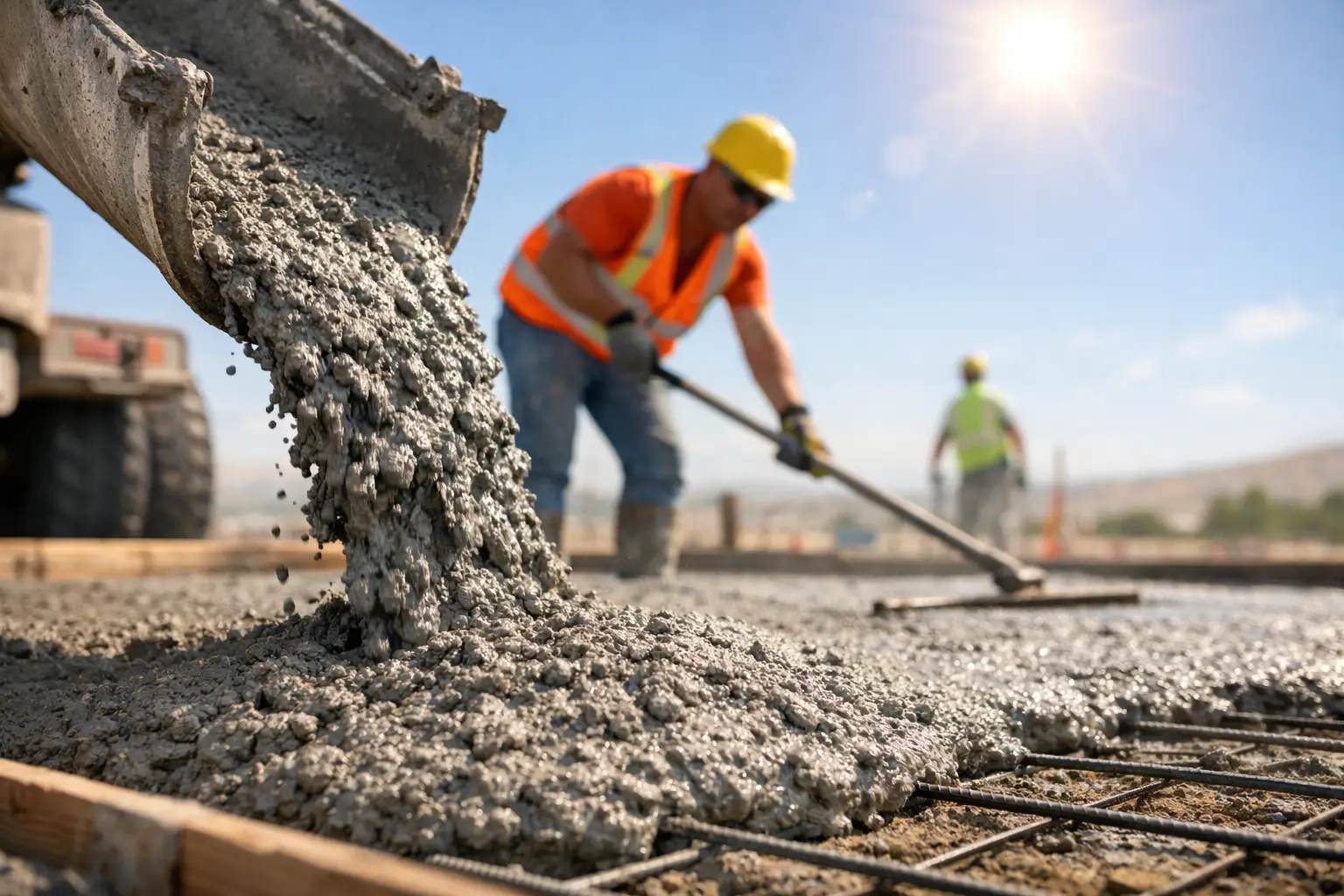
When the concrete truck shows up in July and the slab is already warming under a Texas sun, the job changes fast. Pouring concrete in hot weather is not just a matter of working harder or faster. Heat, wind, and low humidity can shorten set time, increase water demand, and make a good-looking slab much harder to place and finish correctly.
That matters whether you are replacing a driveway, adding a patio, or scheduling a commercial slab. Hot-weather placement can absolutely be done well, but it has to be managed. If it is not, the surface can dry too fast, shrinkage cracks can show up early, and the finished concrete may not perform the way you expected.
Why heat creates real problems for concrete
Concrete does not simply dry. It cures through a chemical reaction between cement and water. High temperatures speed that reaction up. On paper, that might sound like a benefit because the concrete gains strength faster early on. In practice, it often means less working time, more difficulty during finishing, and a greater chance of moisture leaving the surface before the slab is properly cured.
The risk goes up when heat combines with wind and low humidity. Those conditions pull moisture out of fresh concrete at the exact time it needs controlled curing. A surface that loses water too quickly can crust over while the concrete below is still plastic. That creates finishing problems and can lead to surface defects, scaling, and weak top layers.
Hot weather can also raise the temperature of the raw materials before the pour even starts. Warm aggregate, hot subgrade, and direct sun on forms all push the concrete temperature higher. By the time the mix reaches the site, the crew may already be fighting the clock.
What counts as hot weather?
There is no single number that tells the whole story, but concrete work starts to get more demanding when ambient temperatures climb into the upper 80s and 90s, especially with sun exposure and wind. In North Texas and nearby markets, that is normal summer jobsite weather.
The bigger issue is not just air temperature. It is the temperature of the concrete itself, the surface it is being placed on, and the evaporation rate at the slab. A 92-degree day with dry wind can be tougher on a pour than a still 98-degree morning with good prep and shade. That is why experienced crews plan around conditions, not just the forecast high.
Pouring concrete in hot weather starts before the pour
Most hot-weather concrete problems begin with poor preparation. Once the truck arrives, your options narrow quickly.
Scheduling is the first lever. Early morning placements are often the safest choice because the subgrade, forms, and reinforcement have not been baking all afternoon. Starting earlier also gives the crew more control during placement and finishing before peak heat hits.
Subgrade prep matters more than many property owners realize. If the ground is dry and hot, it can pull moisture from the concrete. The base should be properly compacted, correctly graded, and not left in a condition that sucks water out of the slab. Forms and reinforcement that have been sitting in direct sun may also need attention before placement.
The mix design should fit the weather and the application. This is where contractor experience shows. The wrong mix in extreme heat can leave almost no room for error. Adjustments may include admixtures that help control set time or reduce water demand, but that decision needs to match the slab type, thickness, finish requirements, and expected conditions.
The biggest mistake: adding water on site
When concrete starts tightening up in the heat, the temptation is obvious. Add water, loosen the mix, and buy more time. That is one of the fastest ways to hurt the finished product.
Extra water can reduce strength, increase shrinkage, and make the surface more prone to dusting and cracking. It may also create the illusion of workability while weakening the slab. A good crew plans for workability before the pour through proper mix selection, timing, and placement strategy rather than trying to rescue the load at the last minute.
That does not mean every adjustment is automatically wrong. It means changes need to be controlled and based on the mix design, not on guesswork at the back of the truck.
Placement and finishing move faster in the heat
Once the concrete is on the ground, time starts shrinking. Crews need enough labor and a clear sequence for placing, screeding, edging, jointing, and finishing. Delays between steps are much more costly in hot weather because the concrete can move from workable to stubborn very quickly.
This is one reason large slabs and decorative finishes need special attention. A plain broom-finished sidewalk and a stamped patio do not carry the same timing pressure. Decorative work often has a tighter finishing window, and heat can make that window uncomfortably short.
Hot weather also increases the risk of finishing too soon or too late. If the surface appears ready but bleed water has not fully dissipated, sealing that moisture in can weaken the top layer. Wait too long, and the crew may struggle to achieve a consistent finish without tearing the surface. Good finishing in the heat is a judgment call backed by experience, not guesswork.
Curing is where many slabs are won or lost
A lot of people focus on the pour and forget the cure. In hot weather, curing is not optional extra care. It is part of the job.
The goal is to keep moisture in the concrete long enough for proper strength development. If the slab dries out too fast, the surface can suffer even when the concrete looked fine on day one. That is why curing methods and timing matter so much after placement.
Depending on the project, curing may involve water-based methods, curing compounds, or protective coverings. The right approach depends on the finish, site conditions, and how soon the slab needs to handle traffic. What matters most is that curing starts at the right time and is not treated as an afterthought.
For homeowners, this is also the stage where patience matters. Walking on a new patio too early or driving on a driveway before the slab has gained enough strength can create avoidable damage. Heat may speed early set, but that does not mean the concrete is ready for full use.
Cracking risk goes up, but not every crack means failure
Concrete cracks. That is a reality of the material. The goal is to control where cracking happens and reduce the conditions that make it worse.
In hot weather, plastic shrinkage cracking is one of the main concerns. This can happen when moisture evaporates from the surface faster than the concrete can replace it from below. The result may be shallow, early cracks that show up while the slab is still fresh.
Control joints help manage shrinkage, but they need to be placed correctly and cut or tooled at the right time. Waiting too long in hot weather can let random cracking start before the joints are doing their job. Reinforcement also has a role, but it does not stop concrete from cracking. It helps hold cracks tighter and improves overall performance.
This is where a no-nonsense contractor is worth hiring. Good concrete work is not about promising a slab that never moves. It is about using the right prep, placement, joint layout, and curing to produce a slab that performs the way it should.
When postponing the pour makes sense
Sometimes the smartest move is to wait.
If temperatures are extreme, the site is not ready, the crew is stretched thin, or the mix and curing plan are not aligned with conditions, postponing can be the better decision. That is especially true for larger pours, decorative finishes, or projects where appearance matters as much as function.
There is always a trade-off. Delaying a pour can affect schedules, access, and other trades. But redoing failed concrete costs more than waiting for a better window or tightening the plan. A contractor who is willing to say not today is usually protecting the result, not slowing the job for no reason.
What property owners should ask before a hot-weather pour
If your project is scheduled during a stretch of high heat, ask how the crew plans to manage timing, mix performance, curing, and site conditions. You do not need a chemistry lesson. You need clear answers.
A solid contractor should be able to explain when the pour will start, how the slab will be protected during placement, what curing method is planned, and when the concrete will be ready for foot or vehicle traffic. If those answers are vague, that is a warning sign.
For residential and commercial clients alike, pouring concrete in hot weather can go very well when the work is planned correctly. It just leaves less room for sloppy prep, rushed finishing, or shortcuts after the truck leaves.
Good concrete is not about luck with the forecast. It is about controlling what can be controlled, then respecting the conditions you cannot.

