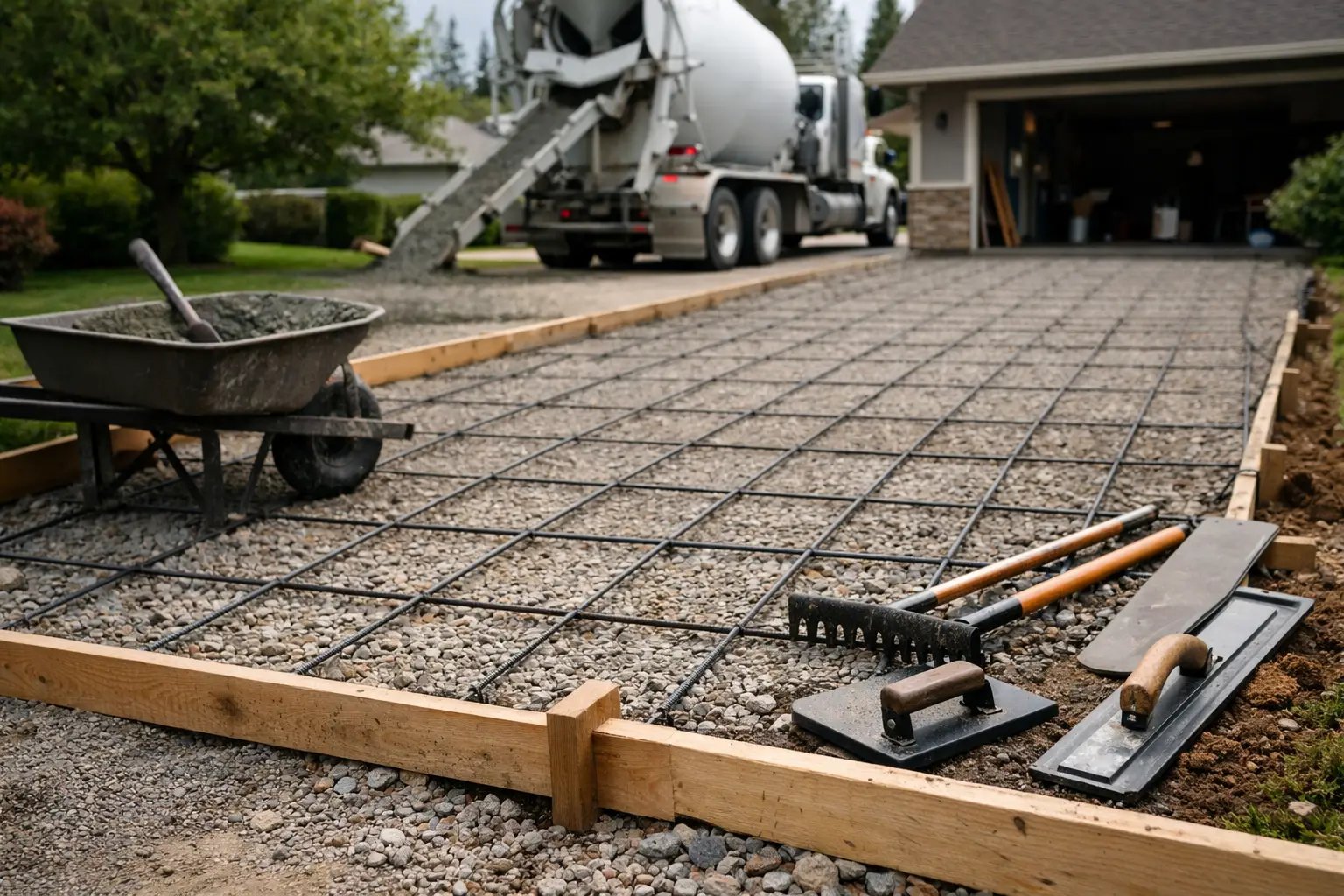
A driveway pour can go sideways before the concrete truck ever shows up. Most problems start in the prep phase - soft subgrade, poor drainage, bad access, or forms that are not set correctly. If you are figuring out how to prepare for driveway pour work, the goal is simple: give the slab the best chance to stay level, drain well, and hold up under traffic for years.
That means preparation is not just about clearing a space and waiting for the crew. It is about soil conditions, thickness, reinforcement, slope, and timing. A good-looking finish matters, but long-term performance starts underneath the concrete.
How to Prepare for Driveway Pour Before the Crew Arrives
Start with the site itself. If there is an old driveway in place, the removal needs to be complete enough that the new slab is not sitting over loose debris or weak spots. Broken concrete, roots, organic material, and soft soil all need to come out. Pouring over unstable ground is one of the fastest ways to end up with settlement and cracking.
The next piece is grading. The area should be cut and shaped to support the finished driveway thickness plus the compacted base. This is where a lot of property owners underestimate the work. Dirt that looks flat is not always properly graded, and dirt that feels firm is not always compacted enough to carry vehicle loads. If the ground pumps, shifts, or stays wet, that issue needs to be addressed before anything else moves forward.
Access also matters more than people expect. The crew needs room for equipment, materials, and concrete delivery. Cars should be moved well in advance, gates should be unlocked if needed, and any obstacles near the work zone should be cleared out. That includes trailers, planters, portable basketball goals, and anything hanging low over the driveway path.
If utilities or irrigation lines run near the area, those should be identified early. The last thing anyone wants is to damage a sprinkler line or discover a shallow utility after excavation starts.
Base Prep Is What Supports the Driveway
Concrete gets the credit, but the base does the heavy lifting. A driveway is only as good as what sits under it. After excavation and rough grading, the subgrade should be compacted, then topped with the right base material if the site calls for it. In many cases, that means crushed stone or road base compacted in lifts.
The exact base depth depends on soil conditions, expected traffic, and the design of the driveway. A standard residential driveway is different from an approach that sees heavier trucks, trailers, or frequent turning loads. In parts of North Texas, expansive clay soils add another variable. Those soils move with moisture changes, so proper base prep and drainage become even more important.
This is one of those areas where cheaper is rarely better. Skimping on excavation or compaction may save money upfront, but it usually shows up later as cracks, low spots, and edge failure. Good prep is not flashy, but it is what keeps the slab performing.
Drainage Should Be Decided Before the Pour
Water is one of concrete's biggest enemies, especially when it collects under or along the slab. The driveway should be pitched to move water away from the house, garage, and other structures. It should also avoid directing runoff where it will cause erosion or ponding.
A proper slope does not need to be dramatic, but it does need to be intentional. If the existing grade traps water, the fix may involve reworking surrounding areas, installing a drain, or adjusting elevations at the garage and street connection. This is not something to guess at after forms are already set.
Drainage is where design and site reality have to meet. A driveway can look perfectly straight and clean, but if it holds water, the finish will age faster and the subgrade may weaken over time.
Forms, Thickness, and Reinforcement
Once the site is excavated and the base is compacted, forms set the shape and final elevation of the pour. They need to be secure, straight where intended, and braced well enough to hold during placement. Loose forms can shift under pressure, and that affects both appearance and slab thickness.
Thickness should match the use of the driveway. For many residential projects, 4 inches may be standard, but some driveways need 5 or 6 inches in higher-load areas. Aprons, approach sections, and places where delivery trucks or RVs may pass often deserve extra attention. This is not an area for assumptions. The right thickness depends on real use, not just what was done at the neighbor's house.
Reinforcement is another point where people get confused. Wire mesh, rebar, and fiber each have a role, but none of them make up for poor soil prep. Reinforcement helps control cracking and adds support, but it does not turn weak ground into a stable foundation. It should be part of a complete plan, not a shortcut.
Expansion and Control Joints Matter
Concrete cracks. The real question is whether it cracks in managed locations or random ones. Control joints help guide shrinkage cracks as the slab cures. Expansion joints help separate the driveway from fixed structures like a garage slab, sidewalk, or foundation.
Joint layout should be planned before the pour. Spacing, depth, and placement all affect performance and appearance. A driveway with no joint strategy may still look good on day one, but random cracking often shows up later.
Practical Site Prep for Homeowners and Property Managers
If a contractor is handling the full scope, much of the technical prep will be covered. Still, the property owner can help the project stay on track by preparing the site around the work zone.
Make sure vehicles are out of the garage and driveway area well before the scheduled pour. If the driveway is the only path to the garage, plan for the fact that access will be cut off not just during placement, but through the initial cure period. That means thinking ahead about parking, deliveries, trash pickup, and foot traffic.
Pets and kids need to stay clear of the work area. Fresh concrete and active equipment are not a mix for distractions. If the driveway ties into a front walk or entry route, you may need a temporary path to reach the house safely.
It also helps to trim back landscaping near the forms. Bushes, low tree limbs, and decorative edging can get in the way of excavation and finishing. If there are fragile items nearby, move them instead of hoping they will be fine.
Weather Timing Can Change the Plan
Weather affects every driveway pour. High heat, direct sun, strong wind, and rain all change how concrete behaves. In hot conditions, the mix can set faster than expected, which puts pressure on placement and finishing. In wet weather, the subgrade can soften, and rain on fresh concrete can damage the surface.
That does not mean every forecast delay is necessary. It does mean timing should be based on site conditions, not convenience alone. A good contractor watches temperature, moisture, and finish window closely.
For owners, the best move is flexibility. If weather forces a schedule shift, that is usually a sign the crew is protecting the result, not dragging out the job.
How to Prepare for Driveway Pour Day and After
On pour day, the main job is to keep the site accessible and let the crew work. Avoid walking through the area, moving cones, or trying to speed up the process. Finishing takes timing, and too much traffic around the slab can create problems.
After placement, curing begins. This is where patience counts. Concrete may look hard within a day, but that does not mean it is ready for vehicles. Foot traffic might be allowed earlier depending on the conditions, but car and truck traffic needs to wait based on the contractor's recommendation.
You should also know what to expect cosmetically. Color variation, light surface dust, and hairline shrinkage can happen even on quality work. That is different from structural failure. The important thing is whether the driveway was built on solid prep, placed correctly, and cured properly.
A clean site helps too. Before the pour, remove anything you do not want splashed with mud or dust. After the pour, expect some construction residue around the edges until final cleanup is done. That is normal on active concrete work.
The best driveway pours are usually the least dramatic. The site is ready, the base is solid, drainage is handled, and the crew can place the concrete without fighting avoidable problems. That is the standard Fantastico Concrete aims for on every project. If you treat prep as the foundation of the job instead of a side detail, the driveway has a much better chance of looking good and staying that way.

