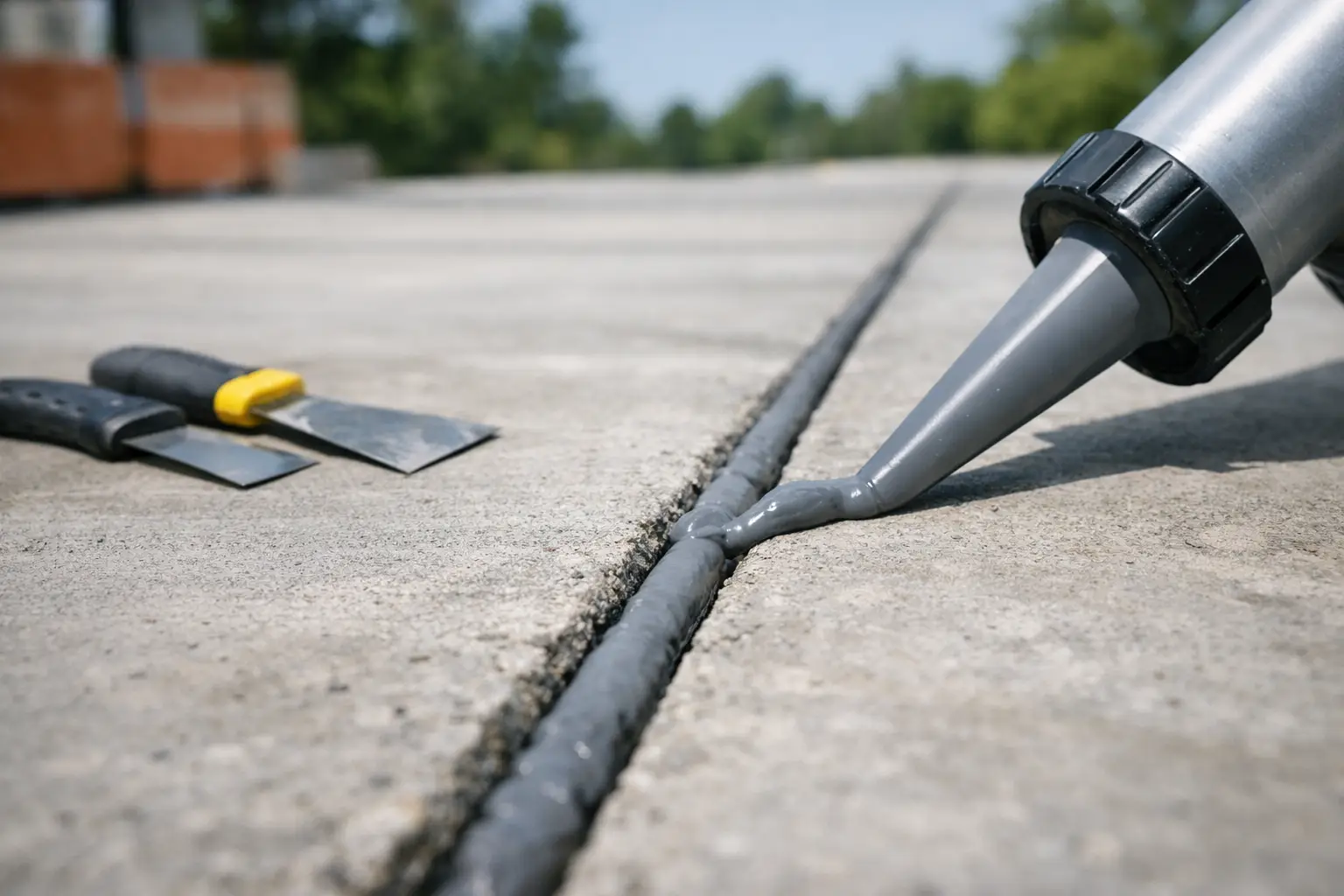
A Dallas-Fort Worth driveway can heat up fast, especially when dark concrete sits in direct summer sun. As the slab expands, it needs somewhere to move. This guide to expansion joints explains how that movement is managed, why the joints matter, and what homeowners and property managers should look for before small concrete issues become costly repairs.
Concrete is strong under compression, but it has very little flexibility. It shrinks as it cures, expands and contracts with temperature changes, and can shift when the supporting soil moves. Proper jointing does not guarantee a slab will never crack. It gives concrete planned locations to move or crack in a controlled way instead of creating random, uneven breaks across the finished surface.
What Expansion Joints Do in Concrete
An expansion joint is a compressible material placed between separate concrete sections or between a slab and a fixed structure. It creates a gap that allows the concrete to expand without pressing hard against a wall, column, curb, pool coping, another slab, or a different part of the building.
On a residential project, expansion joint material is often seen where a driveway meets the garage slab, where a patio meets the house, or where a sidewalk runs into a porch or retaining wall. The material is commonly made from fiberboard, foam, rubber, or another durable compressible product. A flexible sealant may be installed at the top to help keep water and debris out.
Without this separation, expanding concrete can transfer pressure to the adjoining surface. That pressure may cause spalling at slab edges, cracking near the connection point, or damage to finishes around the slab. The joint is a small part of the installation, but it protects the larger investment.
Expansion Joints vs. Control Joints
These terms are often used interchangeably, but they serve different purposes. Knowing the difference makes it easier to evaluate a concrete proposal or discuss repairs with a contractor.
Control joints, also called contraction joints, are intentional grooves cut or tooled into the surface of a slab. They create a weakened plane where concrete is more likely to crack as it shrinks during curing. A control joint is not usually filled with compressible material, and it does not fully separate one slab section from another.
Expansion joints fully separate adjacent concrete sections. They are used at points where movement against a fixed object or neighboring slab could cause damage. Isolation joints are closely related and are often the more accurate term when concrete is separated from a wall, column, footing, or other stationary structure.
A quality flatwork installation typically needs both approaches: control joints laid out across the slab and expansion or isolation joints at the right boundaries. Adding expansion material everywhere is not a substitute for a sound control-joint layout.
Where Expansion Joints Are Usually Needed
Joint placement depends on the slab’s size, thickness, shape, reinforcement, base preparation, and what the concrete touches. Still, several locations regularly call for separation.
A driveway should generally be isolated where it meets a garage slab, especially if the two sections were poured at different times. A patio installed against a home should be separated from the foundation or exterior wall. Sidewalks commonly need expansion joints where they meet steps, porches, curbs, and other hard structures.
Commercial work adds more movement points. Large sidewalks, loading areas, dumpster pads, parking areas, and building entrances may connect to curbs, walls, bollards, utility structures, and multiple slab placements. Each transition needs to be planned so movement does not force one concrete element into another.
In North Texas, expansive clay soils make this planning more important. Soil movement does not turn every joint into a solution for settlement, drainage problems, or poor subgrade. But properly located joints reduce stress where slabs meet, while base preparation and drainage address the support beneath the concrete.
Joints Around Homes Require Extra Care
The joint at the house is especially important. Concrete should not be poured tight against siding, brick veneer, doors, or foundation elements without a proper separation detail. A patio that pushes against the house can cause cracking at its own edge and can create water-management problems if the slope is wrong.
The finished elevation also matters. Concrete near a home must be installed with appropriate clearance from weep holes, siding, and door thresholds, while still sloping away from the structure. Expansion material cannot fix a slab that was poured too high or pitched toward the house.
How Joint Layout Affects Crack Control
Joint placement is not just an appearance decision. The layout determines how the slab handles shrinkage stress. Long, narrow panels are more likely to crack unpredictably than panels that are closer to square. Re-entrant corners, such as the inside corner of an L-shaped patio, are also common crack starting points.
For a typical 4-inch residential slab, control joints are often spaced roughly 8 to 12 feet apart, though the proper spacing depends on the project. A common rule is to keep joint spacing in feet at about two to three times the slab thickness in inches. That is a starting point, not a universal design rule.
Control joints also need enough depth to work. Saw-cut joints are commonly cut to at least one-quarter of the slab thickness. If cuts are too shallow, too late, or poorly placed, the slab may crack before the joints can guide it.
Expansion joints should be placed at true points of restraint, not dropped into the middle of a slab without a reason. For example, a driveway may use control joints to divide its field panels, then use expansion joint material where it meets the garage and other fixed concrete. The correct layout depends on how the slab is shaped and supported.
Materials and Installation Details Matter
A joint can fail even when it is located correctly. Fiber expansion board is common and cost-effective, but it should be installed straight, held firmly in place, and protected from becoming buried under excess concrete. Foam products can offer clean edges and reliable compression, depending on the application.
The top of the joint often needs attention after the concrete cures. An open gap can collect dirt, leaves, and water. In driveways and walkways, debris can pack into the joint and restrict movement. Water can also reach the base beneath the slab, which is a concern where drainage is already weak.
A flexible polyurethane or similar joint sealant can help protect the opening. The right sealant needs adequate joint depth and proper surface preparation. Some joints also require backer rod so the sealant bonds to the sides of the joint instead of sticking to the bottom. This lets the sealant stretch and compress as intended.
Not every concrete joint should be filled with a rigid patch material. Mortar, hard epoxy, or excess concrete inside an expansion joint defeats the point of the joint. If the gap cannot move, the stress will find another path.
Common Problems Homeowners See
Cracked concrete near the garage, patio edge, or walkway connection often points to a missing, damaged, or blocked expansion joint. The cause can also be poor drainage, inadequate base compaction, tree-root activity, or soil movement. A contractor should assess the full condition instead of treating every crack as a joint issue.
Joint material that has deteriorated below the slab surface is another common problem. It may leave a gap that traps water and debris. In many cases, the practical repair is to clean out loose material, install backer rod if needed, and apply an appropriate flexible sealant. If the slab edges are broken, displaced, or severely settled, sealing alone will not correct the underlying damage.
Watch for these signs during routine property maintenance:
- Concrete edges that are chipping or breaking where two slabs meet
- A patio or driveway pressing tightly against a wall, curb, or garage slab
- Joint gaps packed with soil, gravel, leaves, or old rigid filler
- Cracks that begin at inside corners or slab connections
- Standing water along joints or water draining toward the building
When to Repair and When to Replace
A sound slab with worn joint sealant may only need cleaning and resealing. This is often a practical maintenance project that helps protect the base and preserves a clean finished appearance.
Replacement becomes more likely when a slab has major settlement, significant heaving, widespread cracking, poor slope, or failed edges. For example, if a driveway panel has dropped enough to create a trip hazard or has pulled away from the garage, the repair should address the slab support and elevation, not just the visible joint.
Before any new pour, the contractor should review drainage, base condition, reinforcement needs, joint layout, and connections to existing concrete. Fantastico Concrete approaches these details as part of the work, because a clean finish means little if the slab is not built to handle normal movement.
A well-planned joint is easy to overlook when concrete is new. Years later, it is often the detail that keeps a driveway, patio, or sidewalk moving as it should instead of fighting the surfaces around it.

