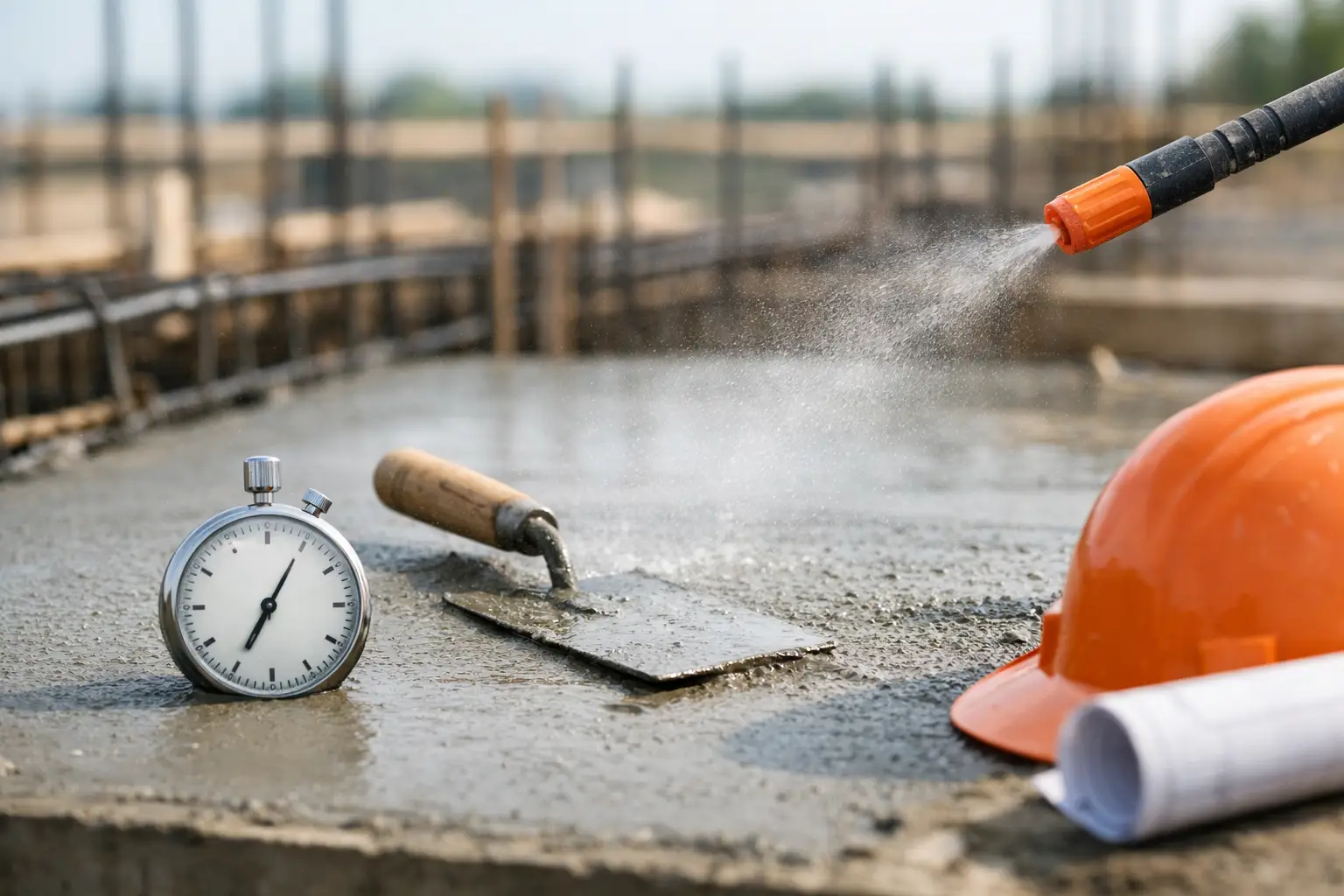
Fresh concrete can look finished in a day and still be far from ready for real use. That gap is where a lot of problems start. This guide to concrete curing time explains what actually happens after the pour, how long different stages take, and why rushing the process can cost you in strength, appearance, and service life.
What concrete curing time really means
Curing time is not the same as drying time. Concrete does not harden because water simply evaporates. It gains strength through hydration, which is the chemical reaction between cement and water. That reaction continues over time, and it works best when the slab holds enough moisture and stays within a reasonable temperature range.
This is why a slab can seem hard on the surface but still be vulnerable underneath. If concrete dries too fast, especially in hot wind or direct sun, the cure can be uneven. That often leads to surface dusting, shrinkage cracks, weaker edges, and reduced long-term durability.
For homeowners and property managers, the practical takeaway is simple. The day the crew finishes the pour is not the day the concrete is fully ready. Good curing protects the investment you just made.
A guide to concrete curing time by stage
Most concrete follows a predictable timeline, but exact timing depends on mix design, weather, thickness, and how the slab will be used.
First 24 hours
In the first several hours, the concrete begins to set. During this period, it is especially vulnerable to impressions, surface damage, and moisture loss. Foot traffic should stay off unless the contractor says otherwise. Pets, ladders, and equipment should also stay away.
By about 24 hours, many residential slabs are firm enough for very light foot traffic. Even then, that does not mean the slab has reached anything close to full strength. It only means the surface has hardened enough to tolerate limited contact.
48 hours to 7 days
Within the first two days, the slab continues gaining strength at a meaningful rate. For many standard flatwork jobs, careful foot traffic becomes more realistic during this window. Heavy furniture, dumpsters, trailers, and concentrated loads are still a bad idea.
By 7 days, concrete may reach roughly 70 percent of its design strength under good curing conditions. That is a useful milestone, but not a green light for every kind of use. A sidewalk may handle normal walking before a driveway can handle vehicle traffic. A patio may look ready long before it should carry a hot tub or outdoor kitchen setup.
Around 28 days
The 28-day mark is the standard benchmark for full design strength in normal concrete work. That does not mean hydration stops on day 28. Concrete can continue to gain strength beyond that point. It simply means 28 days is the industry reference point for when the slab is generally considered cured enough to meet its intended performance target.
If a project will carry vehicles, support structures, or deal with repeated loading, that full curing period matters. Rushing use before then can create problems that never fully go away.
When can you walk, park, or place weight on it?
This is where people usually want a straight answer, and the honest answer is that it depends on the slab and the load.
For sidewalks and patios, light foot traffic is often fine after 24 to 48 hours. For driveways, most contractors recommend waiting at least 7 days before parking a passenger vehicle, and longer if conditions were poor during the cure. Heavy trucks, loaded trailers, and commercial vehicles may require more time.
For furniture and equipment, the safer approach is to think about point loads, not just total weight. A grill with narrow wheels or a chair with sharp metal feet can mark or stress young concrete faster than a broad, evenly distributed load. That is especially true on decorative finishes.
If you are managing a commercial site, caution matters even more. Reopening too soon can lead to tire marks, edge damage, and premature wear that show up right away. In that setting, waiting an extra few days is usually cheaper than repairing a slab that was put into service too early.
Weather changes concrete curing time
In North Texas and Oklahoma, heat is often the biggest curing challenge. High temperatures, sun exposure, and wind can pull moisture from fresh concrete fast. When that happens, the surface can cure too quickly while the interior lags behind. The result can be shallow cracking, curling, or a weaker wear surface.
Cold weather creates a different problem. Hydration slows down as temperatures drop, so strength develops more slowly. If concrete is exposed to freezing conditions before it gains enough early strength, damage can be permanent.
Rain is another variable people misunderstand. A little moisture after initial set is not always bad for curing. In fact, moisture retention helps hydration. But heavy rain too early can wash out the surface, weaken the top layer, and ruin the finish.
This is why experienced contractors adjust timing, finishing methods, and curing practices to conditions on site. The same mix poured in mild weather behaves differently than it does during a Texas summer heat spike.
Why proper curing matters more than most people think
A lot of concrete failures are not really installation failures. They are curing failures. The slab was placed, finished, and jointed correctly, but the cure was rushed or neglected.
Proper curing helps concrete reach better compressive strength, resist abrasion, reduce shrinkage cracking, and hold up longer against weather and traffic. It also improves surface integrity, which matters on driveways, patios, pool decks, and commercial walkways where appearance counts.
If you plan to seal the concrete later, curing matters there too. Sealing too soon can trap moisture and interfere with performance. Waiting until the slab has cured adequately gives the sealer a better chance to do its job.
Common mistakes that shorten slab life
One common mistake is assuming hard equals cured. Another is putting the slab into service based on convenience instead of actual timing. That usually happens when someone wants to park in the driveway early, move patio furniture back too soon, or reopen an access lane before the concrete is ready.
Another issue is poor moisture control after the pour. In hot weather, concrete may need curing compounds, wet curing methods, or protective measures to slow moisture loss. Skipping that step can shave quality off the finished product even if everything else was done right.
There is also the sealing question. People often want a finished look as fast as possible, but early sealing can create more problems than it solves. The slab needs time to cure before many sealers should be applied. Product type matters, so the timing should match the material and the slab condition.
How contractors judge readiness
A good contractor does not rely on one calendar rule for every project. They look at the mix, slab thickness, weather conditions, site exposure, and intended use. A residential patio and a dumpster pad are not judged the same way because they do not carry the same risk.
This is where hiring a concrete specialist pays off. Concrete work is not just about the pour day. It is about planning the cure, protecting the slab, and giving the owner realistic use timelines. Fantastico Concrete approaches curing that way because long-term performance starts before the slab ever sees traffic.
What to ask before the crew leaves
You do not need a chemistry lesson, but you should leave the job with clear instructions. Ask when foot traffic is allowed, when vehicles can use the slab, when heavy items can be placed on it, and whether the weather may change those timelines. If the concrete will be sealed, ask when that should happen too.
Those answers should be specific to your project, not generic. A contractor who gives you one blanket number for every slab, every season, and every use case is oversimplifying the job.
Concrete rewards patience. If you give it the cure time it needs, it has a much better shot at staying strong, looking clean, and doing its job for years. If you are ever unsure whether a slab is ready, waiting a little longer is usually the safer call.

