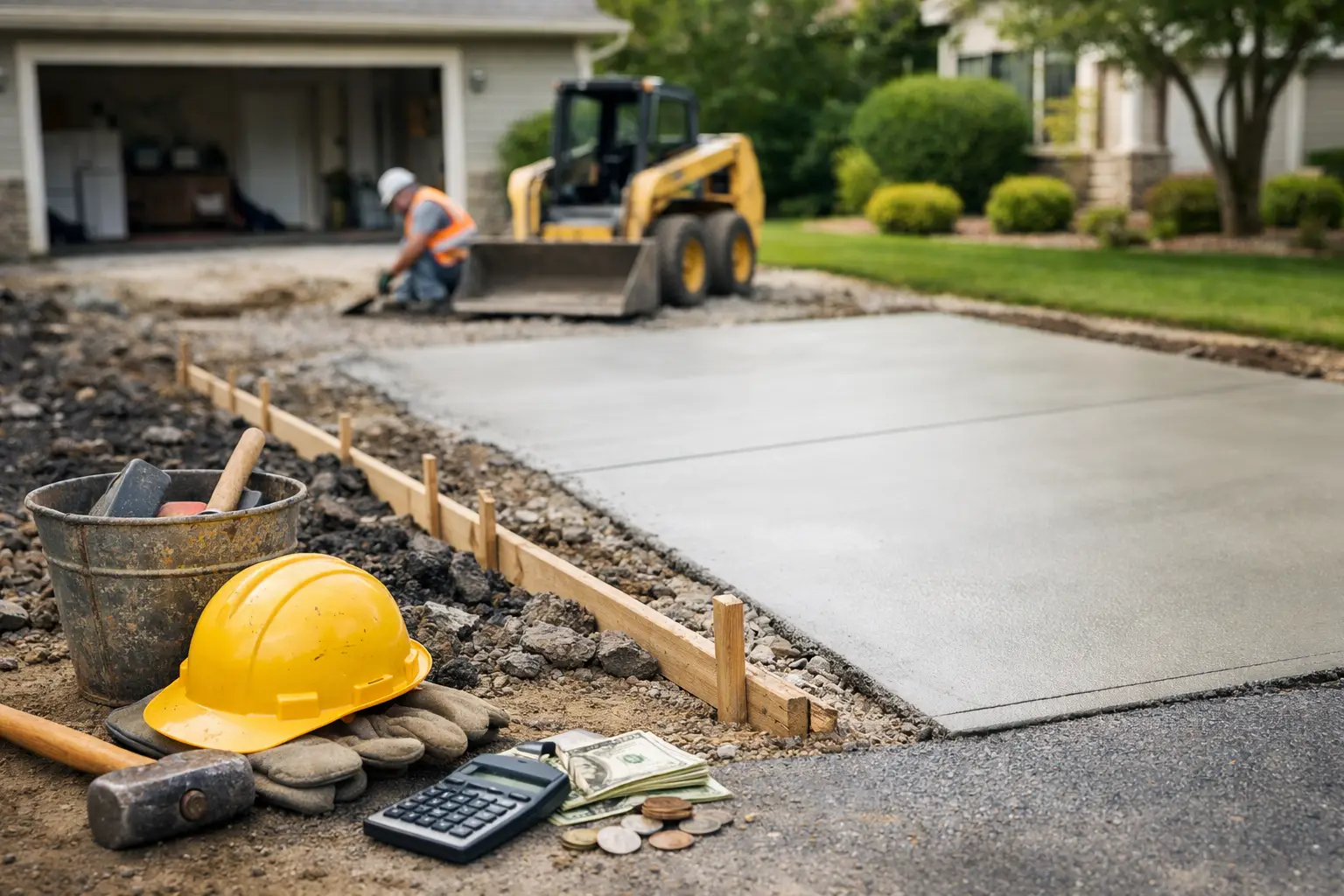
If you are pricing out a new driveway, the number that matters is not a national average. Driveway replacement cost depends on what is already on the ground, what has to be removed, how the base is built, and how well the new surface will handle traffic, weather, and drainage over time.
That is why two driveways with the same square footage can land at very different price points. One may need straightforward tear-out and replacement. The other may need grading correction, thicker concrete, reinforced edges, or drainage work to keep water from pushing under the slab and causing early failure.
What drives driveway replacement cost
The biggest cost factor is usually size, but size is only the starting point. A long, wide driveway obviously uses more material and labor than a short single-car approach. Still, the real price is shaped by the site conditions and the scope of work hidden below the surface.
Removal matters first. Replacing an old driveway often means demolition, hauling away broken concrete or asphalt, and clearing the area for new base prep. If the existing slab is thick, heavily reinforced, or difficult to access with equipment, removal costs go up.
Base preparation is another major variable. A driveway is only as good as the ground under it. If the subgrade is soft, poorly compacted, or uneven, a contractor may need to excavate deeper, import road base, compact in lifts, and stabilize problem areas. That adds cost up front, but it is often the difference between a driveway that holds up and one that starts cracking, settling, or ponding water too soon.
Material choice also changes the price. Plain concrete is a common replacement option because it balances durability, appearance, and long-term value. Asphalt can have a lower upfront cost in some markets, but it performs differently in heat and may require more routine maintenance. Decorative finishes, exposed aggregate, borders, and stamped concrete all raise the price because they add labor, materials, and finishing time.
Thickness and reinforcement matter too. A standard residential driveway may be poured at one thickness, while heavier vehicle use may justify thicker concrete or additional reinforcement. If the driveway serves large trucks, trailers, or commercial traffic, the slab design should reflect that. Paying less for a lighter build can cost more later if the surface is not designed for actual use.
Average price ranges and why they vary
Many homeowners want a per-square-foot number, and that is a useful planning tool, but it should be treated as a rough range, not a final quote. In many cases, concrete driveway replacement is priced by square footage plus demolition, haul-off, grading, forms, reinforcement, and finish details.
For a basic residential concrete driveway replacement, a common range may fall around moderate mid-market pricing per square foot, but that range can shift depending on local labor, access, thickness, and site prep. In parts of Texas and Oklahoma, soil movement and drainage concerns can influence how much prep work is needed before concrete is even poured.
That means a project that looks simple from the street may cost more once the old slab is removed and the underlying conditions are visible. Expansive soils, edge breakdown, tree root pressure, and poor water flow are common reasons estimates move upward.
On the other hand, not every higher quote is overpricing. Sometimes it reflects a more complete scope. A lower bid may cover demolition and a new pour, while a higher one includes proper base replacement, thicker concrete at vehicle paths, control joints placed correctly, and cleanup that leaves the site ready to use. Those are not small differences.
Concrete vs. asphalt vs. decorative finishes
When people compare driveway replacement cost, they are often comparing materials that behave very differently over time. Concrete usually costs more upfront than basic asphalt, but it tends to offer a cleaner finish, strong durability, and lower routine maintenance for many property owners.
Asphalt may appeal if the goal is to reduce initial spend, but hot weather, oxidation, and periodic sealing should be part of the conversation. In warm climates, surface softening and wear can become a concern depending on traffic and sun exposure.
Decorative concrete sits at a higher price point because it does more than provide a driving surface. Stamped patterns, textured finishes, coloring, and custom borders improve curb appeal, but they also require more labor and tighter installation control. If appearance matters for a front-entry home, upscale rental, or commercial property, the added cost may make sense. If the goal is function first, plain broom-finished concrete is often the better fit.
There is no universal best choice. The right material depends on budget, expected traffic, maintenance tolerance, and how much visual impact you want from the finished surface.
Site conditions that can change the price fast
Some of the most expensive issues in driveway replacement are not visible until the project starts. Drainage is one of them. If water runs toward the garage, pools near the street, or washes out the edges, the new driveway may need slope correction or added drainage features. That work protects the slab, but it adds labor and materials.
Access is another common issue. If equipment cannot reach the driveway easily, demolition and concrete placement become slower and more labor-intensive. Tight side yards, fences, landscaping, and nearby structures all affect production.
Permits and municipal requirements can also come into play. Some areas require specific apron details, sidewalk tie-ins, or approach standards near the curb. If the replacement affects public walkways or city right-of-way, the scope may expand beyond the driveway itself.
Then there is timing. If a contractor has to phase the work around occupancy, business access, tenant use, or limited curing windows, that can influence the job cost. Simple projects are cheaper to produce than projects with scheduling constraints and traffic management concerns.
How to read an estimate the right way
A driveway quote should be more than a square-foot price scribbled on a page. You want to know what is included, what assumptions are being made, and what could trigger added cost after work begins.
Look for clear language on demolition, haul-off, excavation depth, base material, compaction, concrete thickness, reinforcement, jointing, finish type, and cleanup. If drainage correction is needed, that should be spelled out. If it is not included, ask whether the contractor sees any water-flow concerns that could affect performance.
It also helps to ask what is excluded. Some estimates do not include permit fees, replacement of adjacent sidewalks, irrigation repairs, or sealing. None of that is automatically a problem, but you should know it before comparing bids.
A good estimate should also reflect how the driveway will actually be used. A light-duty residential slab is not the same as a driveway that regularly carries work trucks, delivery vehicles, or RV traffic. If the design does not match the use, the lower price may not be the better value.
When repair makes sense and when replacement is smarter
Not every damaged driveway needs full replacement. If the issue is limited to one section, a targeted repair may buy time. Minor surface wear, isolated cracking, or a small broken panel can sometimes be addressed without removing the whole driveway.
But patching has limits. If there is widespread cracking, settlement, heaving, drainage failure, or edge breakdown across multiple areas, replacing only part of the driveway can turn into repeated spending. It may fix the appearance temporarily without solving the root problem.
Replacement usually makes more financial sense when the slab has reached the point where structural issues are spread across the surface. That is especially true if the base has failed or water is causing ongoing movement. At that stage, putting money into piecemeal repair often delays the real fix.
How to budget without guessing
The best way to budget is to start with your actual goals. Are you replacing the driveway because it is unsafe, because it looks worn out, because drainage is causing problems, or because you need a stronger surface for heavier use? The answer affects the scope.
If budget is tight, be clear about where to spend and where to keep things simple. Structural prep, proper thickness, reinforcement, and drainage are not the places to cut corners. Decorative upgrades usually can wait if the priority is durability.
It is also smart to build a little room into the budget for unknowns. Once demolition starts, hidden conditions may show up. A realistic contingency keeps those surprises from stalling the project.
For property owners in areas with heat, shifting soils, and heavy seasonal rain, a driveway is not just a cosmetic surface. It is a working concrete structure that needs to shed water, support weight, and stay stable over time. That is why the cheapest replacement is not always the lowest cost in the long run.
A solid driveway should look right on day one and still do its job years later. When you compare estimates, focus on the build behind the finish. That is where the real value is.

