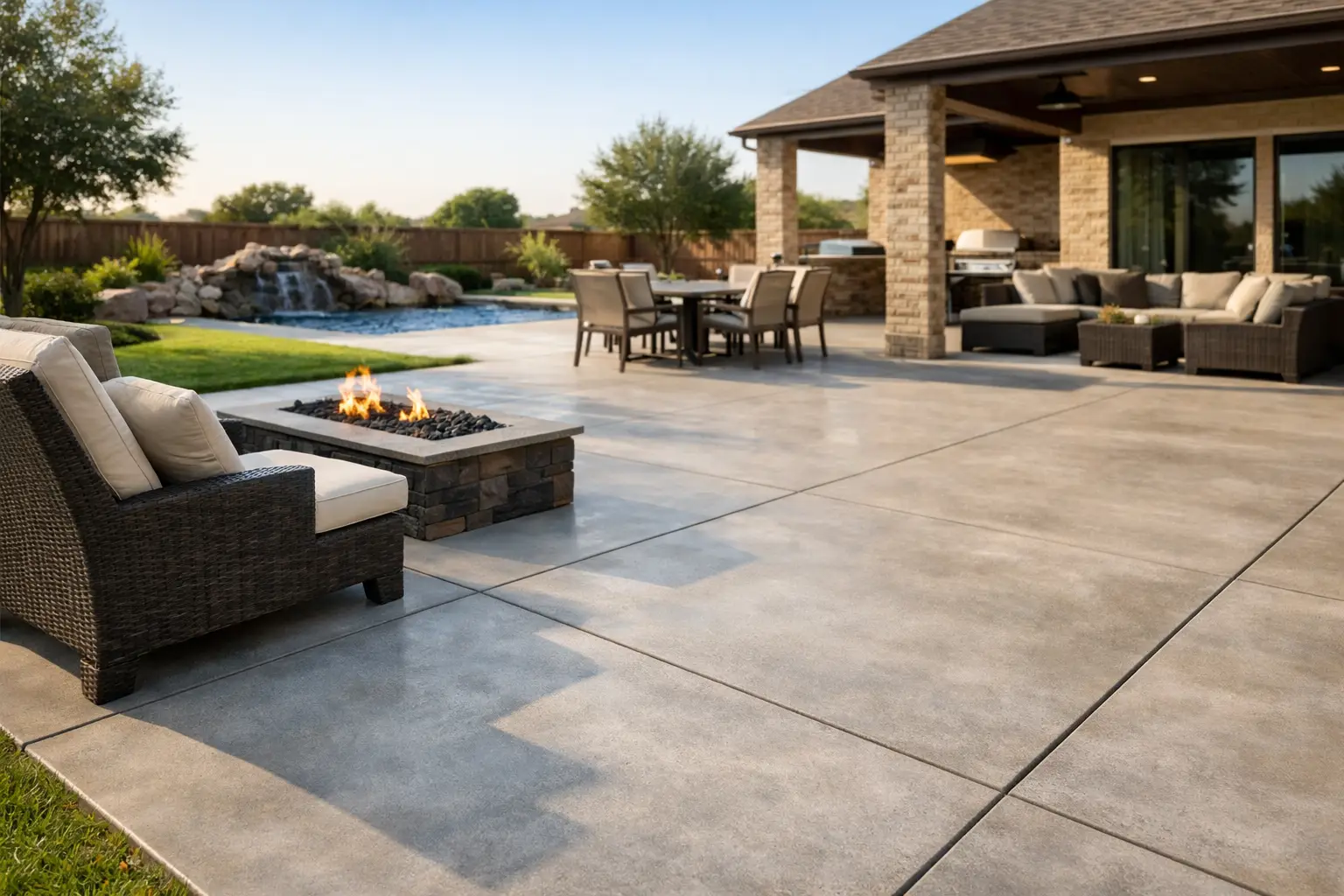
A backyard patio in Dallas has to do more than look good on day one. It has to handle long heat spells, sudden downpours, shifting clay soil, foot traffic, grills, furniture, and regular use without turning into a cracked, puddling mess. That is why concrete patios Dallas property owners invest in should be planned around performance first, then finish and style.
A good patio gives you usable outdoor space, cleaner transitions from house to yard, and a surface that holds up better than many quick-fix alternatives. A bad one usually shows its problems fast. Water sits where it should drain. Edges settle. Cracks spread wider than expected. The surface becomes more maintenance than value. The difference is rarely just the concrete itself. It comes from grading, base prep, thickness, joint placement, and whether the patio was built for the site it sits on.
What makes concrete patios in Dallas different
North Texas conditions are hard on flatwork. Expansive soils move with moisture changes, which means a patio cannot be treated like a simple slab dropped into the yard. If the grade is off or the subgrade is not properly prepared, movement tends to show up sooner rather than later.
Heat matters too. Concrete expands and contracts. In full sun, surface temperatures get high, especially on darker decorative finishes. Then storms roll through, and water management becomes the next test. A patio that does not drain away from the home is not just inconvenient. It can create standing water, erosion around the edges, and added stress near the foundation.
This is why a patio project should start with the site, not the color chart. Shape, slope, access, soil behavior, and intended use all affect what the finished concrete should be.
Choosing the right patio for the way you use it
Some patios are little more than a pad outside the back door. Others need to function like an outdoor room. The right size and layout depend on how the space will actually be used.
If the goal is a place for a table, a grill, and easy walking room, a simple rectangular patio may be enough. If you want space for seating zones, a fire feature, planters, or a path connection, the shape and dimensions need more thought. Too many homeowners go small to reduce the upfront cost, then regret it once furniture starts filling the space.
For rental properties and commercial spaces, function often comes before style. Clean access, durability, and low maintenance usually matter most. For a primary residence, appearance tends to carry more weight, but performance still has to come first. A decorative surface does not make up for poor drainage or weak prep work.
Plain, broom, stamped, or stained?
Concrete gives you a wide range of finish options, but each one comes with trade-offs. Plain gray concrete with a broom finish is still one of the most practical choices. It is cost-effective, slip resistant, and fits almost any property style. If the job needs durability and straightforward maintenance, this option earns its place.
Stamped concrete adds pattern and visual character. It can imitate stone, brick, or tile while keeping the strength of a poured slab. It works well when curb appeal matters and the patio is part of a broader outdoor design. The trade-off is that stamped surfaces require more careful installation and maintenance. If the pattern is overdone or the color does not fit the home, it can look dated faster than a simpler finish.
Staining and color can improve the look of a basic patio without going fully decorative. This can be a good middle ground for owners who want more than plain gray but do not want the cost or upkeep of heavily patterned work. The key is restraint. Natural, durable-looking finishes usually age better than highly stylized ones.
Why base prep matters more than most people realize
The surface gets the attention, but the real work is underneath. A patio is only as reliable as the ground supporting it. That starts with excavation to the right depth, proper grading, and a compacted base that can support the slab over time.
Skipping or rushing this part is one of the easiest ways to create future problems. You might not see a problem right after the pour. You will see it months later when one corner drops, a low spot holds water, or cracking starts to travel. In areas with active soil movement, proper prep is not an upgrade. It is basic job quality.
Thickness matters as well. A standard residential patio may perform well at one thickness, while a surface expected to handle heavier loads or certain site conditions may need more. Reinforcement can also play a role, but reinforcement does not replace good prep. It helps the slab perform better. It does not fix weak support underneath.
Drainage is part of the patio, not a separate issue
One of the most common patio mistakes is treating drainage like an afterthought. It is not. A patio should move water where it needs to go, away from the house and away from spots where standing water will create long-term trouble.
That usually means building in the correct slope from the start and paying attention to nearby downspouts, yard grade, and existing drainage paths. Even a visually clean patio can become a problem if it sends water back toward the home or traps runoff against other structures.
This is especially important when replacing an old patio. If the old slab failed, the cause may not have been age alone. It may have been poor drainage, inadequate base prep, or a layout that never fit the site. Replacing the surface without correcting the cause often means repeating the same problem.
Concrete patios Dallas owners can maintain without hassle
A patio should not become a maintenance project every season. That is one reason concrete remains a strong choice for both residential and commercial properties. It is durable, straightforward, and easier to keep up than many segmented surface options.
That said, low maintenance does not mean no maintenance. Concrete benefits from routine cleaning, occasional sealing when the finish calls for it, and basic attention to small issues before they become larger ones. If tree roots are pushing nearby sections, drainage changes are washing out edges, or joints are filling with debris and growth, those are worth addressing early.
For decorative concrete, maintenance tends to depend on the finish. Stamped and colored patios may need resealing to keep their appearance and surface protection intact. Broom-finished concrete usually asks less of the owner. The right choice depends on how much appearance matters compared to long-term upkeep.
When replacement makes more sense than repair
Not every cracked patio needs to be torn out. Minor surface wear, isolated cracking, or cosmetic issues can sometimes be addressed without full replacement. But there is a point where patching becomes temporary money.
If the slab has multiple settlement areas, widespread cracking, drainage failure, or major surface deterioration, replacement is often the better move. Repairs may improve the look for a short time, but they usually cannot correct underlying structural or grading problems. A fresh pour built on the same failed conditions is not much better. The real value comes from fixing the source of the failure.
Property owners often try to stretch an old patio one more season, which is understandable. But if the space is no longer safe, functional, or draining properly, delaying replacement can lead to bigger issues around surrounding walkways, landscaping, and adjacent structures.
What to ask before hiring a patio contractor
A patio contractor should be able to explain the job in practical terms. How will the site be graded? What base prep is included? What thickness is planned? How will joints be placed? How will water move off the patio? Those answers matter more than a fast promise or a low number.
It also helps to ask how the patio design fits the way you plan to use the space. A contractor focused only on the pour may miss layout issues that affect daily use. A good project is not just structurally sound. It works well once furniture, foot traffic, and weather become part of the equation.
For property owners in Dallas-Fort Worth and across North Texas, local experience matters because regional soil and weather conditions affect performance. Fantastico Concrete approaches patio work with that practical reality in mind - build it for the site, not just the sale.
The best patio is the one that still works years later
A concrete patio should give you dependable space, not new problems to manage. Good design matters. Clean finishes matter. But the basics decide whether the project holds up: proper prep, correct drainage, sensible layout, and workmanship that respects the conditions on the ground. If the patio is built right, you notice it less over time, and that is usually a good sign.

