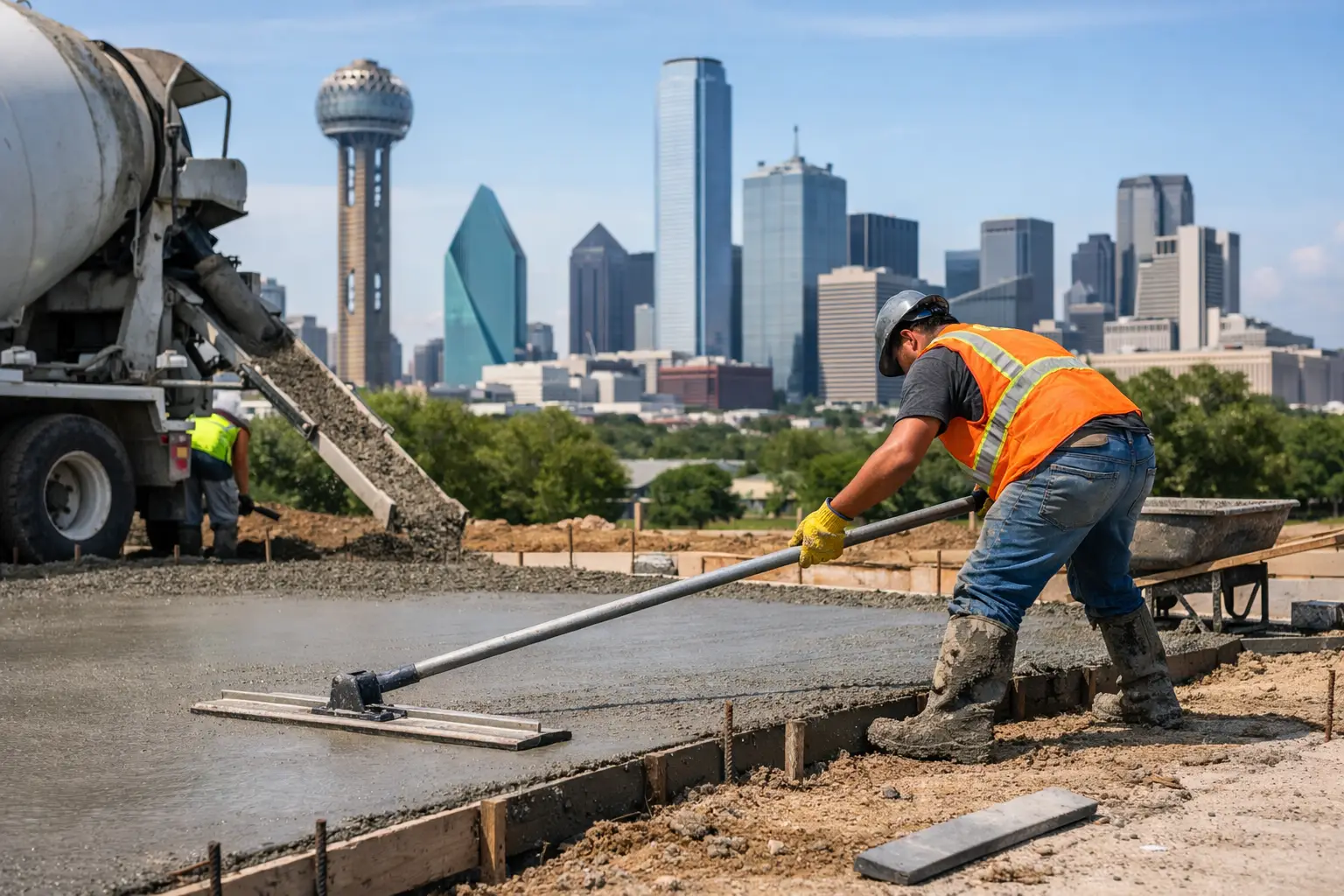
If you are pricing a new driveway, patio, sidewalk, or slab, concrete installation cost usually comes down to a simple question: what exactly has to happen on your site to get a durable finished surface. Square footage matters, but it is never the whole story. In Dallas-Fort Worth, soil movement, drainage, access, thickness, reinforcement, and finish details can change the number fast.
That is why two projects with the same dimensions can land at very different price points. A basic rectangular patio poured on an accessible, level yard is a different job than a driveway replacement with demolition, grading correction, forms, steel, and a finish that has to look clean from the street. If you want a realistic budget, you need to know what contractors are actually pricing.
What affects concrete installation cost
The biggest cost driver is the scope of the work. New concrete is not just the pour. A proper installation can include demolition, haul-off, excavation, grading, forming, base preparation, reinforcement, concrete placement, finishing, cutting control joints, curing, and cleanup. When any one of those steps gets more demanding, the total goes up.
Project size still matters because larger pours require more material and labor. At the same time, very small jobs can carry a higher price per square foot because mobilization, setup, and crew time do not disappear just because the footprint is smaller. That catches some property owners off guard.
Thickness is another major factor. A backyard patio and a commercial approach do not require the same structural performance. Thicker concrete uses more material, often needs more reinforcement, and may call for more subgrade work. If the slab will carry vehicles, dumpsters, equipment, or repeated heavy traffic, the installation has to match that use.
Site conditions also have a direct effect on price. If access is tight, crews may need more time or different equipment to move material. If the grade is off or drainage is poor, prep work becomes more involved. In North Texas, expansive clay soil is part of the conversation. If the base is not handled correctly, you can end up paying less upfront and more later in cracking, settling, or water problems.
Typical price ranges by project type
Concrete installation cost is usually discussed by square foot, but the useful number for most owners is the total project range. A sidewalk, patio, driveway, and slab each have different demands, so comparing one to another does not tell you much.
A basic residential patio is often one of the more straightforward flatwork projects if the yard is accessible and the shape is simple. Pricing tends to stay more manageable when there is little excavation, no decorative finish, and no major drainage correction. Once curves, borders, color, texture, or difficult backyard access enter the picture, the budget moves.
Driveways usually cost more than patios because they have to perform under vehicle load and they are often more visible. Replacement work can include saw cutting and demolition of existing concrete, haul-off, deeper base work, thicker sections, and attention to approach transitions. If the driveway ties into the garage, street, or drainage path in a tricky way, that matters.
Sidewalks and walkways can look simple, but layout, tree roots, slopes, and city or HOA requirements can affect labor. A long straight path is generally easier to estimate than a winding walkway with elevation changes and tight forms.
Slabs for sheds, shops, dumpster pads, equipment areas, or commercial use can vary even more. Utility requirements, edge thickening, reinforcement, and load expectations all push the final number. For commercial properties, scheduling and access can add cost too, especially if work has to happen around tenants, deliveries, or business hours.
Why prep work changes the price so much
If there is one part of a quote that property owners tend to underestimate, it is prep. Good concrete starts before the truck arrives. The subgrade has to be stable, the base has to be right for the application, and water has to move away from the slab instead of under it or toward structures.
Grading correction can be a major line item because it affects both performance and labor. A slab poured on a poor base may look fine on day one and start showing settlement, ponding, or edge failure later. That is not a finish problem. It is a prep problem.
Demolition is another price driver. Removing old concrete takes labor, equipment, and disposal. If the existing slab is reinforced heavily or tied into adjacent structures, removal becomes slower and more precise. Haul-off costs also depend on volume and site access.
In some cases, prep work lowers long-term cost even if it raises the estimate. Spending more to correct grade, improve drainage, or strengthen the base can be the better value when it helps the slab last longer and perform the way it should.
Finish, design, and reinforcement upgrades
Not every concrete surface is a plain gray broom finish. Many owners want a cleaner look, better slip resistance, decorative texture, or a layout that fits the property. Those choices are valid, but they change labor and material requirements.
A standard finish is usually the most budget-friendly option. Decorative work such as stamping, staining, exposed aggregate, saw-cut patterns, or custom borders adds time, craftsmanship, and sometimes additional products. The result can improve curb appeal or tenant appeal, but it should be priced as an upgrade, not treated like a small add-on.
Reinforcement also affects cost. Depending on the project, that may include rebar, wire mesh, or other structural support. The right reinforcement depends on thickness, load, soil, and intended use. More steel is not automatically better if the slab design and prep are wrong, but the correct reinforcement matters.
Edge details, steps, retaining transitions, and drainage features can also raise the price. These are not cosmetic extras in every case. Sometimes they are necessary to make the concrete safe, usable, and compliant with the site.
Residential vs. commercial concrete installation cost
Commercial concrete installation cost is often higher because the job itself is more demanding. The slab may need to handle heavier loads, meet stricter specs, or work around occupied spaces. Scheduling can become part of the cost when crews need to phase the project to reduce disruption.
Residential jobs are usually more flexible, but homeowners still face cost swings based on design and site conditions. A simple front walkway is one thing. A large backyard patio with drainage correction, custom finish work, and access issues is another.
For investors and property managers, speed matters too. A cheap quote that leads to delays, callbacks, or premature failure can cost more in vacancy, tenant complaints, or repeat work. That is where contractor experience starts to show up in the real value of the estimate.
How to compare quotes without getting misled
A low number can look good until you realize what is missing. When reviewing estimates, check whether demolition, haul-off, base prep, reinforcement, thickness, jointing, cleanup, and curing are clearly included. If one quote is far below the others, there is usually a reason.
You should also look at how the contractor is addressing your actual site. Are they accounting for drainage, soil conditions, and intended use, or are they pricing it like a generic flat pad. Concrete is not a one-price commodity. The details matter because the performance depends on them.
It is also worth asking what finish is included and whether any permit or inspection requirements apply. That is especially important for commercial work or projects near public access points. Clear scope now prevents disputes later.
A contractor should be able to explain where the money is going in plain terms. That does not mean every estimate will be identical. It does mean the reasoning behind the price should make sense.
What to expect when budgeting your project
The best approach is to budget with some flexibility instead of chasing the lowest possible number. If your project involves replacement, drainage correction, difficult access, or decorative upgrades, expect the concrete installation cost to reflect that reality. Trying to force a complex job into a basic-job budget rarely ends well.
For Dallas-Fort Worth properties, local conditions matter. Soil movement, heat, stormwater flow, and the age of surrounding surfaces all influence how a slab should be built. A contractor who works in this market regularly will factor those conditions into the estimate instead of treating the job like a generic pour.
At Fantastico Concrete, the practical goal is simple: price the work for what the site actually needs, then build it to hold up. That is what owners are paying for when they hire a specialist instead of hoping cheap concrete turns into a long-term fix.
If you are planning a concrete project, the smartest first step is not hunting for the lowest square-foot price. It is getting a clear assessment of the site, the intended use, and the prep required to do the job right.

