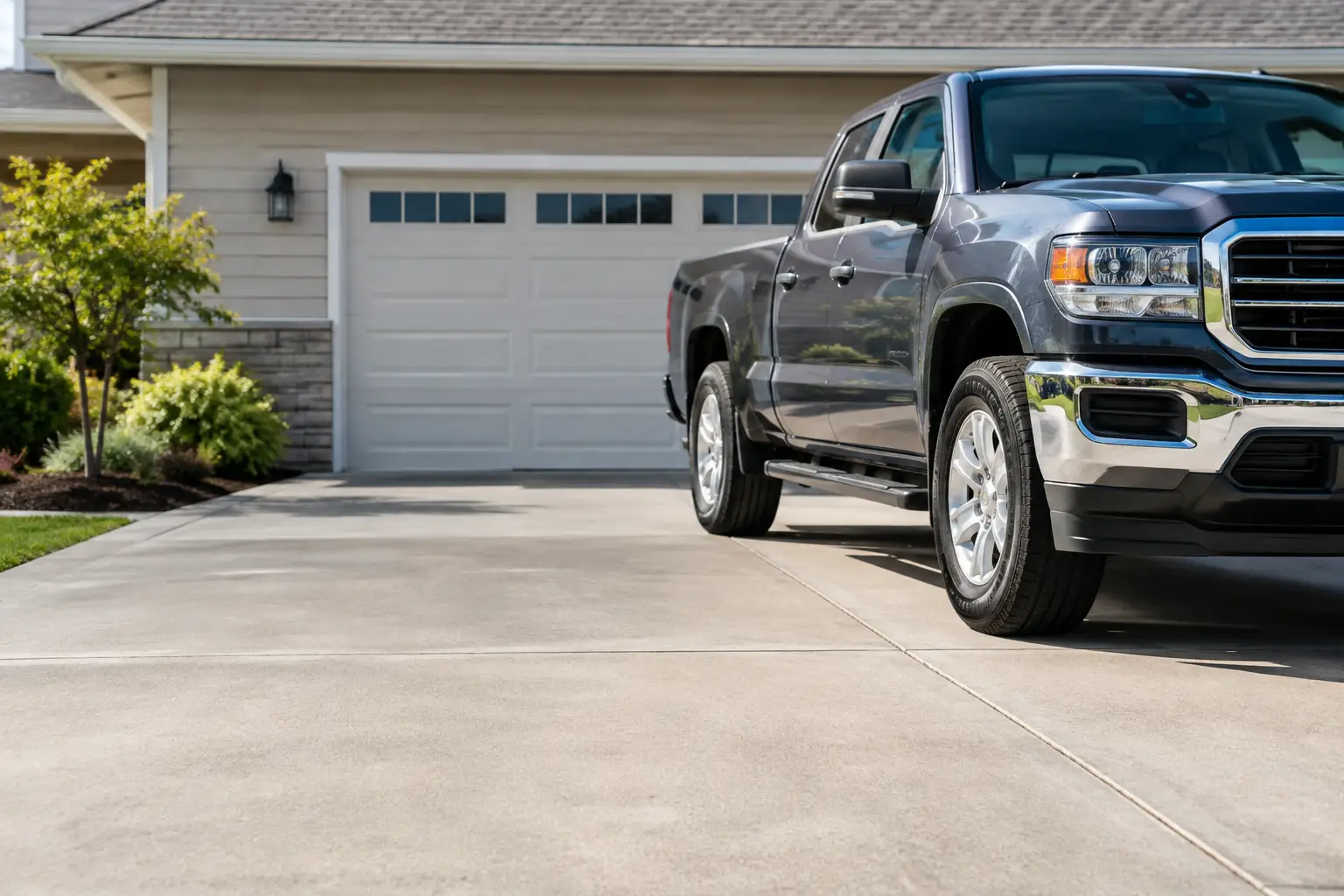
A driveway can look solid and still be the wrong surface for the vehicle using it. Concrete driveway weight limits are not determined by thickness alone. The vehicle’s axle weight, the condition of the soil, the base beneath the slab, drainage, joint layout, and concrete strength all affect whether a driveway holds up or starts cracking at the edges.
For most homes, a properly built residential driveway handles passenger cars, SUVs, pickups, and occasional service vehicles without trouble. Problems usually begin when a driveway designed for normal household traffic becomes a regular parking spot for a heavy work truck, RV, trailer, dumpster, or delivery vehicle.
There Is No Single Concrete Driveway Weight Limit
It is tempting to ask for one number: how many pounds can a concrete driveway hold? In the field, that question needs more context. A 7,000-pound pickup distributes its weight very differently than a 7,000-pound trailer or a loaded work truck. Two vehicles with the same total weight can put very different stress on the concrete.
What matters most is concentrated load. Tires transfer force to relatively small areas, and the highest stress is often near slab edges, control joints, corners, and areas where the base has weakened. A heavy vehicle turning its tires while stopped can also create more stress than one rolling straight across the same slab.
A driveway’s real capacity comes from the complete system below and above grade. Concrete is strong in compression, but it does not perform well when unsupported sections bend under load. That is why a thick slab placed on poor, wet, or shifting soil can still crack early.
What a Typical Residential Driveway Is Built to Handle
A standard residential concrete driveway is commonly 4 inches thick and built for ordinary passenger vehicles. When the subgrade is properly prepared and compacted, a 4-inch driveway can serve cars, crossovers, SUVs, and light-duty pickups well for years.
That does not mean every 4-inch slab is equal. A driveway poured over loose fill, poorly compacted dirt, or expansive clay has less support than one built over a stable, compacted base. In North Texas, clay soils can swell when wet and shrink during dry periods. That movement can leave voids below a slab or push sections upward, reducing the driveway’s ability to carry heavier traffic.
For regular use by heavier pickups, work vans, trailers, or larger SUVs, a 5-inch driveway often provides a better margin. Driveways expected to support heavier commercial-type traffic, RVs, moving trucks, or frequent deliveries may require 6 inches or more, along with a stronger base and details designed for those loads.
Thickness is only one part of the decision. A thicker slab without good ground preparation is not a dependable heavy-duty driveway.
Vehicle weight is not the whole story
Consider these common examples. A typical sedan may weigh 3,000 to 4,500 pounds. A full-size pickup can weigh 5,000 to 7,500 pounds before passengers, tools, or cargo. Loaded work trucks, motorhomes, box trucks, and concrete or construction delivery vehicles can weigh far more.
More importantly, a vehicle’s axle arrangement changes the load placed on the slab. A rear-loaded work truck may concentrate substantial weight over one axle. A trailer may place high force on a small number of wheels and even more pressure where stabilizers or trailer jacks contact the concrete. A dumpster can create severe point loads that a normal driveway was never intended to receive.
If a vehicle will sit in one place for long periods, that also changes the design conversation. Parking a loaded trailer in the same location day after day is different from a moving truck making one brief visit.
The Parts of a Driveway That Control Its Strength
Concrete contractors look beyond the visible surface when planning for weight. Four elements deserve close attention: soil, base, slab thickness, and drainage.
The soil must be evaluated and prepared before placement. Soft areas, organic material, loose fill, and unstable spots should be removed or corrected. On clay-heavy properties, proper grading and drainage matter because water changes how the soil behaves. A driveway that stays wet at the edges or receives roof runoff is more likely to shift and lose support.
A compacted granular base helps create a uniform platform beneath the concrete. The right base depth depends on site conditions and intended use, but its job is straightforward: reduce uneven support, improve drainage, and help the slab carry loads more consistently. Skipping this step to save time can cost far more after cracking appears.
Concrete thickness should match the planned traffic. A driveway built for family vehicles should not automatically be expected to perform as a commercial truck pad. If heavy vehicles are part of the plan, the design should account for them before the pour, not after the first crack.
Drainage completes the system. Water should move away from the driveway and should not collect under or alongside the slab. Poor drainage softens subgrade, contributes to erosion, and increases movement in reactive soils. In the Dallas-Fort Worth area and throughout much of Texas and Oklahoma, managing water around concrete is not optional maintenance. It is part of a durable installation.
Reinforcement Helps, but It Does Not Replace Proper Design
Rebar, wire mesh, and fiber reinforcement are often misunderstood. Reinforcement can help hold cracked sections together and limit crack separation, but it does not turn a thin slab on weak ground into a heavy-duty surface.
Proper control joints are equally important. Concrete shrinks as it cures, and cracks are expected in large flatwork if that movement is not managed. Control joints create planned locations for cracking. They need to be placed at appropriate spacing and cut deeply enough to do their job.
For heavier-use driveways, reinforcement and doweled joints may be part of the design. The exact approach depends on the slab layout, expected traffic, soil conditions, and whether the driveway ties into a garage, street, sidewalk, or existing concrete. There is no benefit to adding materials at random. The details should solve the actual site conditions.
Warning Signs Your Driveway Is Carrying Too Much
A single hairline crack does not always mean a driveway is overloaded. Concrete cracks for many reasons, including shrinkage, temperature changes, soil movement, and weak joints. The pattern and location of damage tell a more useful story.
Watch for cracks that widen over time, broken slab corners, settled wheel paths, crumbling edges, or one section sitting lower than the next. Cracks near the edge where heavy vehicles park are especially common when the slab lacks support. Spalling, or flaking at the surface, may point to finishing issues, moisture exposure, deicing chemicals, or freeze-thaw conditions, but repeated heavy traffic can make it worse.
If a heavy truck or RV needs access, avoid driving close to unsupported slab edges. Do not let vehicles cross sharp drop-offs, and do not assume a thin apron at the street has the same capacity as the main driveway. Aprons, culvert crossings, and transitions often need separate attention because they experience concentrated wheel loads.
Plan for the Heaviest Realistic Use
The best time to address concrete driveway weight limits is before construction. Think beyond the vehicle you own today. Will a work truck be parked there? Is an RV, boat trailer, or food truck likely to use the property? Will a moving truck, dumpster, or delivery truck need to cross the slab? Is the driveway also an access route to a shop, detached garage, or commercial rear entry?
Be direct about those plans during the estimate. A contractor can recommend a thicker slab, stronger base, reinforced turning areas, or a dedicated parking pad where it makes sense. Those upgrades cost more upfront, but replacing cracked concrete after the fact is rarely the cheaper route.
For existing driveways, the practical answer may be to limit heavy traffic rather than test the slab’s limits. Keep dumpsters and heavy equipment off residential flatwork when possible, use a designated access route, and place RVs or trailers on a purpose-built pad. If repeated heavy use is unavoidable, an experienced concrete contractor can assess whether replacement, extension, or a reinforced section is the right fix.
A driveway should be built for the life you actually use, not just the vehicle parked there on pour day. When heavy traffic is part of the picture, a clear plan for soil preparation, thickness, drainage, and traffic patterns gives the concrete its best chance to stay level, safe, and serviceable.

