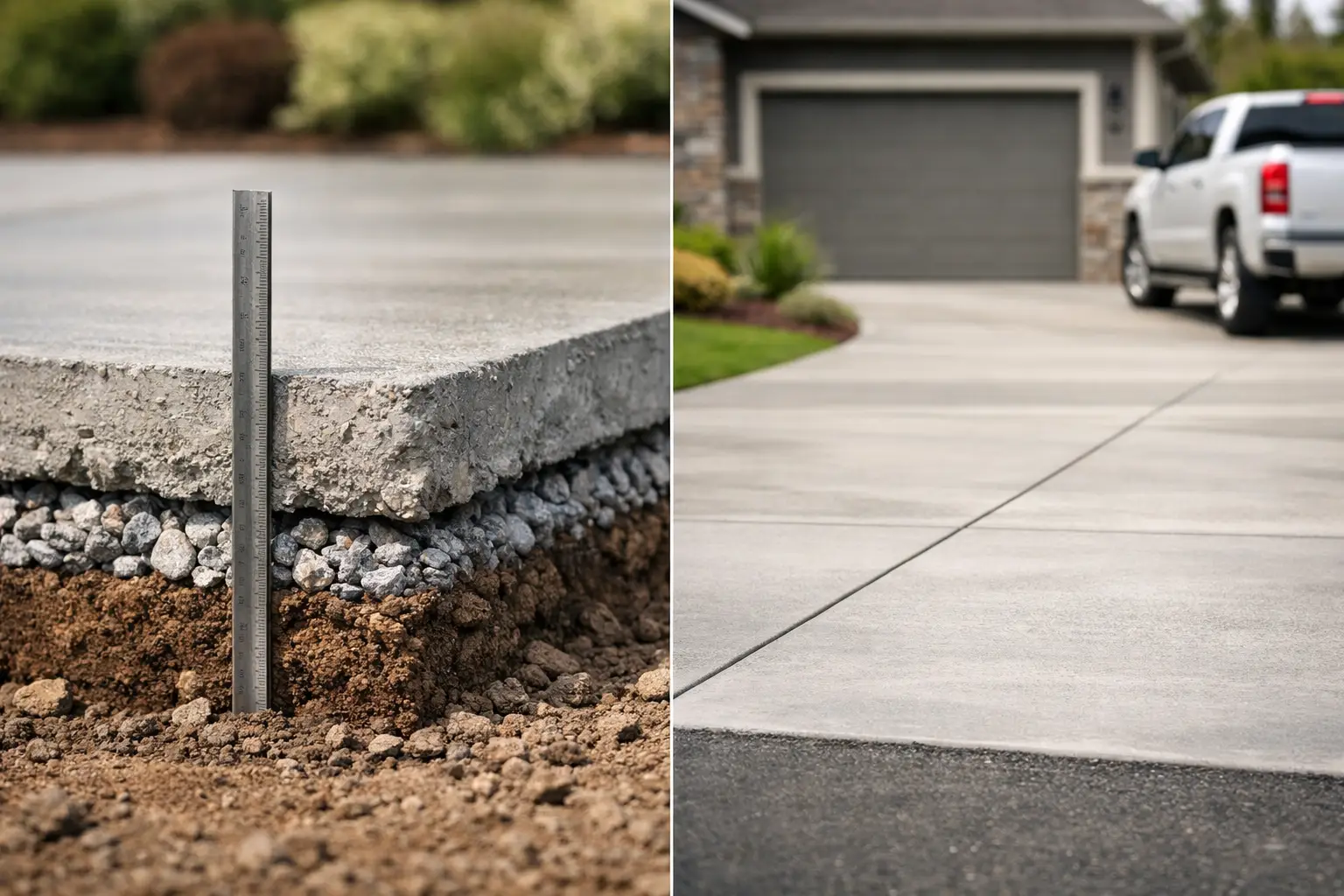
A driveway can look fine on day one and still be headed for trouble if the slab is too thin. That is why a concrete driveway thickness guide matters before any forms are set or concrete is poured. Thickness is not just a number on a quote. It affects cracking, load capacity, lifespan, and how well the driveway handles real traffic over time.
Most residential owners ask one simple question: how thick should a concrete driveway be? The short answer is that 4 inches is the standard for many homes, but that is not always enough. Vehicle weight, soil conditions, base preparation, drainage, reinforcement, and edge support all matter. A driveway built for a compact sedan is not the same as one that regularly carries a lifted truck, trailer, delivery van, or RV.
Concrete driveway thickness guide: the standard answer
For a typical residential driveway, 4 inches of concrete is the common baseline. That thickness works well for normal passenger vehicles when the subgrade is properly compacted and the base is prepared correctly. In other words, 4 inches can perform well, but only when the rest of the system is done right.
For heavier residential use, 5 inches is often the smarter call. That extra inch gives the slab more strength against repeated loads and can help reduce the risk of premature cracking or settlement issues. If the driveway will see larger pickups, work trucks, loaded trailers, or frequent service vehicles, going thicker is usually money well spent.
For commercial driveways or access areas with regular heavy traffic, 6 inches or more may be needed. At that point, the slab design should match the expected use, not just a generic rule of thumb. A thin slab under heavy traffic may hold up for a while, but it usually catches up with you.
Why thickness alone is not enough
People often focus on slab depth because it is easy to measure and easy to compare between bids. The problem is that concrete performance depends on more than slab thickness. A 5-inch driveway over weak, poorly compacted soil can fail sooner than a 4-inch driveway built on a solid, well-prepared base.
The subgrade is a major factor. If the native soil shifts, holds too much moisture, or was not compacted properly, the slab can settle or crack regardless of thickness. In parts of North Texas, expansive clay soils make this especially relevant. Soil movement can stress concrete from below, so thickness should be considered alongside base prep and drainage planning.
The base layer matters too. A stable crushed stone or similar base helps distribute loads and gives the slab better support. Without that support, pressure points form and weak areas show up faster. Thickness helps, but support underneath the slab is what lets that thickness do its job.
When 4 inches is enough
A 4-inch driveway is generally suitable for standard residential use. That means normal cars, SUVs, and light pickups coming and going under regular daily conditions. If the driveway is not unusually wide, the soil has been addressed properly, and water is directed away from the slab, 4 inches is often a practical and cost-effective choice.
This is also where workmanship becomes a major factor. A true 4-inch slab should actually be 4 inches throughout, not thin in spots because of poor grading or careless finishing. Consistent depth matters. If a contractor promises 4 inches but the slab ends up shallow along the edges or in the center, that changes performance.
For many homeowners, the right answer is not the thickest driveway possible. It is the right thickness for the way the driveway will actually be used.
When 5 inches makes more sense
A lot of residential driveways are asked to do more than they used to. Larger vehicles are common, and many households have multiple drivers, work trucks, or trailers. In those cases, 5 inches gives more margin for load stress and long-term wear.
This is especially true if vehicles tend to follow the same path every day. Repeated wheel loads create concentrated stress. A thicker slab handles that routine better than a minimum-depth slab. If there is any doubt about future use, many property owners prefer to build a little stronger now rather than replace concrete early.
There is also the issue of edges. Driveway edges are vulnerable because they carry weight without support beyond the slab. A thicker section or thickened edge can help in these areas, especially where vehicles turn, park near the edge, or enter from the street at an angle.
Heavy vehicles change the equation
If you plan to park an RV, box truck, dumpster truck, loaded trailer, or commercial vehicle on the driveway, standard residential thickness may not be enough. These loads place much higher stress on the slab and often require a stronger design overall.
That usually means more than just adding an inch of concrete. It may involve a thicker slab, stronger reinforcement, a better base, and closer attention to joint layout. The key is matching the build to the load. A driveway that occasionally sees a moving truck is one thing. A driveway that regularly holds heavy equipment is another.
For commercial sites, apartment properties, or mixed-use spaces, slab thickness should be based on actual traffic patterns. Guessing low to save money up front often leads to repairs, replacement, or liability issues later.
Reinforcement helps, but it does not replace thickness
Reinforcement is useful, but it is often misunderstood. Wire mesh, rebar, or fiber reinforcement can help control cracking and improve slab behavior, but it does not make a too-thin driveway acceptable. If the slab is undersized for the load, reinforcement will not solve the basic problem.
Rebar is often used in driveways that need extra strength, particularly where soil conditions are poor or loads are heavier. Fiber can also help reduce shrinkage cracking. The right reinforcement depends on the project, but it should support the slab design, not compensate for cutting corners.
Joint placement matters here as well. Concrete cracks. The goal is to control where it cracks. Proper control joints help manage shrinkage and reduce random surface cracking. Even a thick driveway can look rough if the joints are poorly spaced or poorly cut.
Drainage and soil movement matter in the real world
A driveway does not fail only because a car drove on it. Water is often part of the story. If water drains under the slab, softens the base, or pools around edges, the concrete loses support. That can lead to cracking, heaving, erosion, or settlement.
Good slope and drainage planning protect the slab. In regions with shifting soils and weather swings, this is not optional detail work. It is part of building a driveway that lasts. A concrete contractor should look at where water will go during heavy rain, not just where the driveway will sit on a dry day.
In Dallas-Fort Worth and other parts of Texas, heat, soil movement, and intense storms can expose weak driveway construction fast. A slab that is barely thick enough on paper may not hold up well if drainage and subgrade work are ignored.
Common mistakes when choosing driveway thickness
One common mistake is assuming all residential driveways need the same depth. They do not. Use matters. Soil matters. Drainage matters. A standard answer is useful, but it is still a starting point.
Another mistake is comparing bids based only on price per square foot without asking what thickness is included and whether that thickness is consistent across the whole slab. Lower pricing sometimes comes from thinner pours, weak base prep, or shortcuts at the edges.
The third mistake is planning only for current use. If a homeowner expects to buy a heavier truck, add a trailer, or convert a property to rental use, it makes sense to think ahead. A slightly thicker slab during installation is much cheaper than replacing a failed driveway later.
What to ask before the pour
Before approving a driveway project, ask what thickness is being recommended and why. Ask what kind of base will be installed, how the soil will be prepared, what reinforcement will be used, and whether the edges will be thickened where needed. A serious contractor should be able to explain the reasoning in plain terms.
This is also the time to mention how the driveway will actually be used. If there are heavy trucks, work trailers, or frequent deliveries, say so early. A good recommendation depends on accurate information.
Fantastico Concrete approaches driveway work the practical way: build for the load, build for the site, and do not treat thickness like the only decision that matters.
The right driveway thickness is the one that fits your property, your traffic, and your ground conditions. If you get that part right before the pour, the rest of the project has a much better chance of lasting the way it should.

