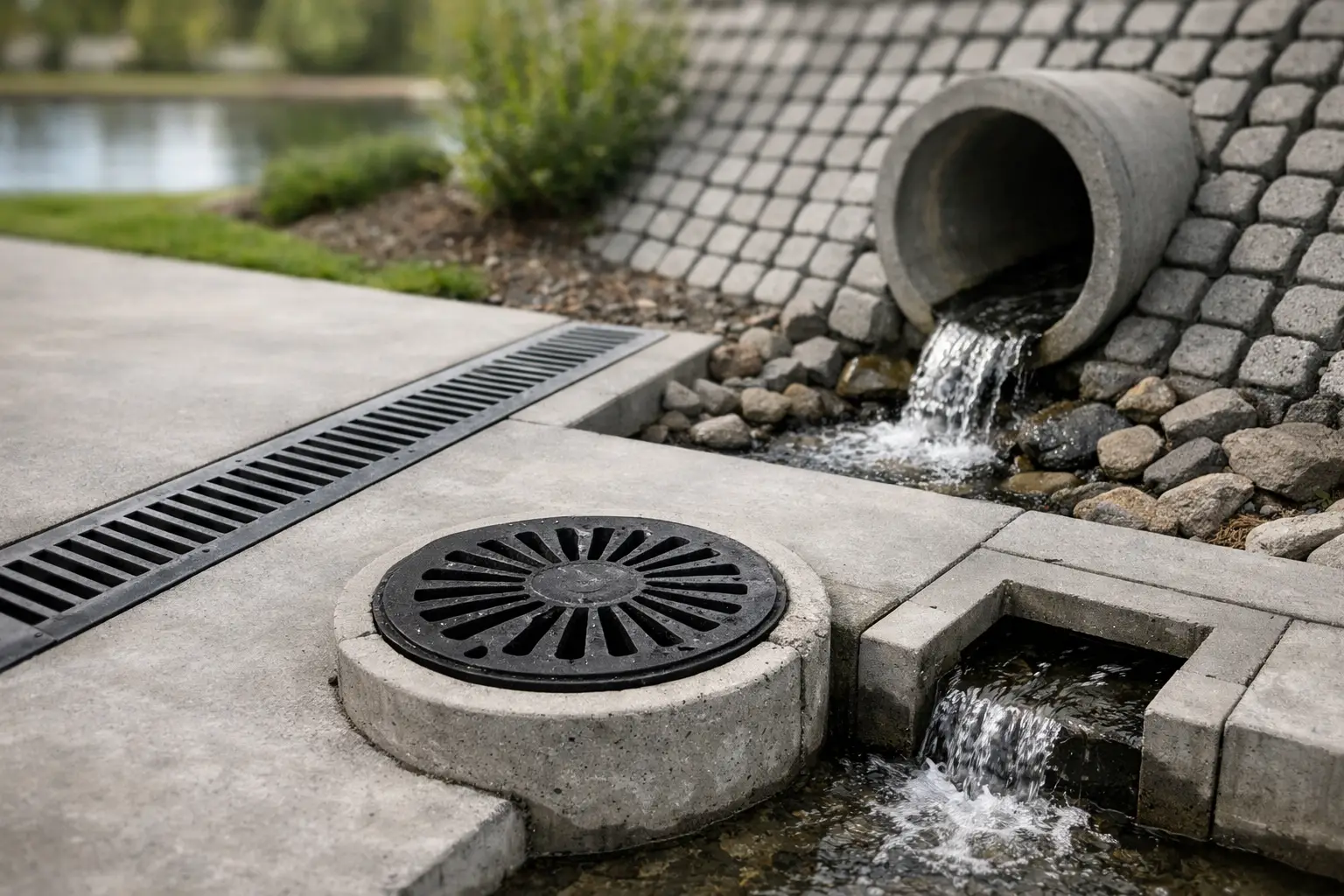
Standing water on concrete is not a small problem. It stains surfaces, creates slip hazards, speeds up cracking, and slowly pushes water where you do not want it - toward foundations, landscaping, and interior spaces. Good concrete drainage solutions are built into the project from the start, not added as an afterthought when the puddles show up.
For homeowners and property managers, that usually means looking beyond the surface. A driveway that looks clean on day one can still fail if it was poured flat, pitched the wrong way, or installed without a plan for runoff. The right fix depends on the site, the slope, the amount of water, and what sits around the concrete.
Why drainage matters in concrete work
Concrete handles traffic, weather, and time better than many surface materials, but it is not immune to bad water management. When water sits on a slab or repeatedly runs across the same edge, the damage tends to show up in predictable ways. You may see scaling, surface discoloration, joint wear, soil washout, or settlement at the perimeter.
Drainage problems also affect how a space gets used. A patio with standing water stays slick and dirty. A sidewalk that drains into a low spot can become a hazard. A commercial apron with poor runoff can leave customers and tenants stepping through puddles every time it rains.
In North Texas and nearby markets, drainage can be especially tricky because the weather swings hard. Long dry periods can shrink soils, then heavy storms hit fast. That cycle puts pressure on both the subgrade and the concrete above it. If runoff is not directed correctly, movement below the slab can become just as much of a problem as water on top of it.
Concrete drainage solutions start with slope
The most effective drainage system is often the simplest one: proper slope. If a slab is poured with the right pitch, water moves off the surface naturally without relying on drains, pumps, or extra maintenance. That is true for driveways, patios, walkways, dumpster pads, and many commercial flatwork areas.
The challenge is that slope has to be balanced. Too little pitch and water ponds. Too much and the surface can feel awkward to walk on, send runoff too quickly, or create problems where the water ends up. A good installer looks at the whole area, not just the slab itself. Where is the water coming from? Where can it safely go? What is downhill from the pour?
This is where some projects get into trouble. A contractor may focus on tying a new slab neatly into an existing structure, but if that tie-in forces the concrete to drain toward a garage, storefront, or house, the finish quality stops mattering. Water always wins.
Driveways and approach areas
Driveways need runoff control for both usability and durability. The surface should move water away from the home and away from edges that are likely to erode. In some cases, that means a steady pitch from garage to street. In others, especially on larger or irregular lots, the driveway may need a cross slope or a drainage channel to intercept flow before it reaches a structure.
Approach areas matter too. If water is allowed to rush off the driveway into weak soil, the edges can start to break down. That is how small drainage issues turn into cracking, undermining, and expensive repairs.
Patios and pool surrounds
Patios need enough fall to move water off the slab, but comfort matters here more than almost anywhere else. People notice unevenness under patio furniture, grill stations, and foot traffic. The best patio drainage plan keeps the slope subtle while directing runoff toward open yard space, drains, or designated collection points.
Pool decks are even less forgiving. Water is already part of the environment, so drainage has to handle both rainfall and splash-out. A deck that holds water becomes slick fast, and runoff should never be allowed to collect near the home or around structural elements.
When surface drains make sense
Not every drainage issue can be solved with slope alone. Some lots are too flat. Some areas sit between structures. Some remodels have to work around existing elevations that cannot realistically be changed. In those cases, surface drains can be a smart part of the solution.
Channel drains are common where water needs to be collected and redirected before it crosses a traffic area or reaches a building. You often see them near garage entrances, patio transitions, loading areas, and commercial thresholds. They work well, but only if they are set at the correct elevation and connected to a proper discharge point. A drain that has nowhere to send water is just a narrow trench.
Area drains can also help in low spots where runoff naturally gathers. These are useful in some courtyards, landscape transitions, and paved sections boxed in by grade. Still, they are not a substitute for poor slab design. If a large surface is draining into one tiny collection point, the system may clog, overflow, or require more maintenance than the owner expects.
Subgrade and base work are part of drainage
A lot of drainage talk focuses on visible water, but what happens under the concrete matters just as much. If the base is not prepared correctly, water can weaken the support beneath the slab. That leads to settlement, rocking sections, and cracks that are less about the concrete mix and more about the ground below it.
Proper grading and compaction help reduce that risk. On some projects, the base material also plays a role in how water moves through or away from the slab area. The right approach depends on soil conditions, expected load, and the surrounding site layout.
This is one reason there is no one-size-fits-all answer. A residential backyard patio and a commercial service lane may both need concrete drainage solutions, but the design priorities are not the same. One may focus on comfort, runoff direction, and appearance. The other may need to account for heavier loads, larger water volume, and stricter performance demands.
Common drainage mistakes in concrete projects
Poor drainage usually comes from a few repeat problems. The slab may be poured too flat. The finish elevations may be set to match an existing surface without checking the overall runoff path. Expansion joints may be planned correctly while the slope is ignored. Or the project may rely on a drain without enough capacity or fall to make it work.
Another common issue is solving one problem by creating another. For example, pushing water off a patio and directly onto a neighboring walkway can fix ponding in one area while creating a slip hazard in another. Sending driveway runoff into a planting bed may look harmless at first, but repeated flow can wash out soil and expose edges.
Short-term fixes can also be misleading. Sealers, patch materials, and surface coatings may improve appearance, but they do not correct drainage. If the slab still holds water, the underlying problem remains.
Choosing the right concrete drainage solutions for your property
The best approach starts with a site-specific assessment. Look at where water lands during a storm, where it pools after, and how the surrounding grade affects movement across the property. A good contractor will check the slab, the nearby elevations, and the discharge path together.
For some properties, the answer is a new pour with proper pitch and base prep. For others, it may be a combination of selective replacement, regrading, and drainage collection. On larger commercial sites, the solution may include multiple control points to manage runoff across traffic areas and building entrances.
Budget matters, but so does scope. A lower-cost fix can make sense if the issue is isolated and the existing concrete is still structurally sound. If the slab is already failing, layering a drainage add-on over bad concrete often delays the real repair instead of preventing it.
That is where working with a concrete specialist makes a difference. Companies like Fantastico Concrete understand that drainage is not a side detail. It is part of how the slab performs over time, how safe it feels underfoot, and how well the whole site holds up after repeated weather cycles.
What property owners should ask before starting work
Before any pour or repair begins, ask where the water will go. Not just off the slab, but all the way through the site. Ask how the finished elevation will affect nearby doors, garages, curbs, landscaping, and neighboring flatwork. Ask whether the proposed slope is enough, whether a drain is actually needed, and who is accounting for subgrade stability.
Clear answers matter more than fancy language. Good drainage planning should be easy to explain because it is based on visible logic: collect water, move it, and keep it away from places that should stay dry and stable.
If your concrete already holds water, do not wait for the damage to get obvious. Drainage problems rarely stay cosmetic for long. The right fix is the one that treats the surface, the slope, and the site as one system - because that is how water sees it.

